


A changing mole deserves careful assessment, although a change alone does not mean cancer. If you are concerned about a lesion, a dermatologist mole check marylebone gives you a private consultation to discuss it with a clinician and understand the next steps.
At Cosmetic Facial, Dr Faramarz Didar is a GMC-registered GP with specialist dermatology training and an MSc in Dermatology Skills and Treatment, awarded with Commendation. A mole check involves more than looking at the skin with the naked eye. Dermoscopy provides magnification and illumination to help assess a lesion’s features, and the findings are explained so you know what action, if any, is recommended.
This guide covers what to look for, what to expect from a professional skin assessment in Marylebone, and how medical evaluation differs from a cosmetic concern. If removal is appropriate, clinical reasons come first, with the appearance of the treated area also considered.
Key Takeaways
- Dermoscopy helps a clinician examine features of a suspicious or changing lesion more closely.
- A targeted assessment may suit a specific concern, while a full-body skin check gives a broader overview.
- A dermatologist mole check marylebone can help you understand the findings and the next steps recommended after assessment.
- Further investigation may be appropriate for a suspicious mole. Decisions about removal should follow clinical assessment.
- At Cosmetic Facial, medical evaluation comes first, and the appearance of a removal site can also be discussed when relevant.
Why Professional Mole Screening is Essential for Skin Health
A professional mole check is a clinical assessment of one or more skin lesions, usually including dermoscopy. This handheld tool magnifies the area and illuminates it, helping a trained clinician assess structures and patterns that may not be visible to the naked eye. Dermoscopy can identify features that warrant further investigation, but it cannot confirm cancer on its own.
Melanoma incidence in the UK has risen, with Cancer Research UK reporting more than 20,000 cases annually. Melanoma is the most dangerous type of skin cancer that can arise from a mole or develop as a new lesion. Reading what is melanoma can provide background, but a changing or concerning spot needs individual clinical assessment. Do not rely on online information or appearance alone to decide whether a lesion needs attention.
For people living or working in Central London, skin checks can form part of ongoing healthcare, particularly if frequent travel means substantial ultraviolet exposure. Stress alone is not an established reason to screen more often, and annual checks are not necessary for everyone. The right interval depends on personal risk factors, skin history and clinical advice. A dermatologist mole check marylebone provides an opportunity to discuss these factors and have a specific concern assessed.
The ABCDE Rule: What to Monitor at Home
Use the ABCDE guide to notice changes, not to diagnose a mole yourself:
- Asymmetry: one half differs from the other.
- Border: edges look irregular, blurred or uneven.
- Colour: there are multiple shades or a recent colour change.
- Diameter: the lesion is larger than before. Size alone cannot show whether it is harmless.
- Evolving: its size, shape, colour, surface or sensation changes over time.
Self-checks can help you notice changes, but they do not provide clinical magnification or specialist interpretation. If you are monitoring a lesion, keep dated photographs, using similar lighting and distance each time where possible. This can help you describe changes during your appointment. Arrange an assessment for a new or evolving lesion rather than waiting for a routine check.
Medical vs Cosmetic Mole Concerns
A mole may need medical assessment because it has changed, or removal may be considered because it catches on clothing or causes aesthetic concern. Assessment should come first, since a lesion that needs investigation should not be treated as a purely cosmetic issue. Skin tags and warts can resemble moles but are different types of skin growth. They can also be assessed and managed in a clinical setting. For broader skin concerns, read about a private dermatologist consultation in London.
What to Expect During Your Marylebone Mole Check
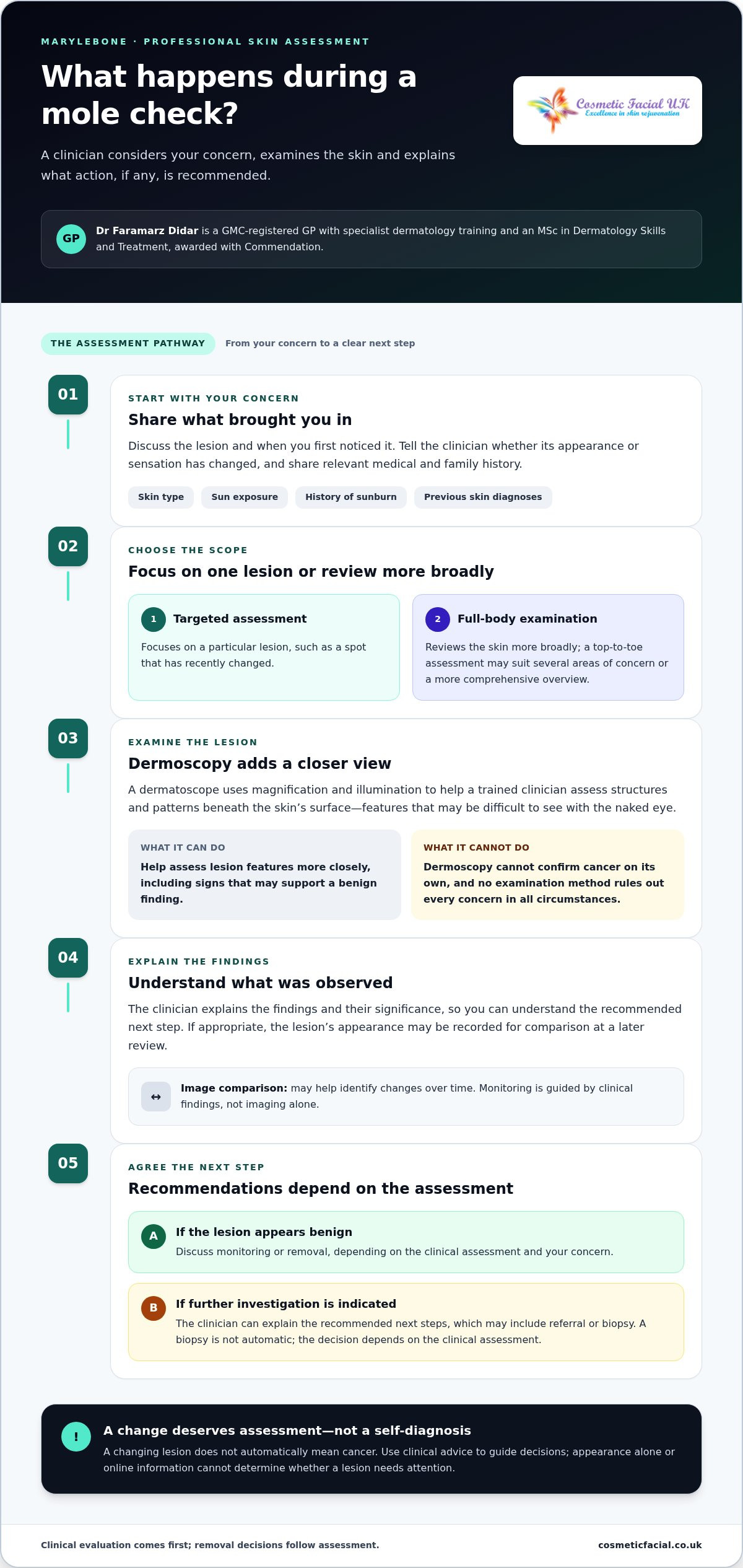
A mole assessment at Cosmetic Facial begins with a clinical consultation, not simply a scan of the skin. Dr Faramarz Didar, a GP with specialist dermatology training, will consider your reason for attending and relevant medical and family history. Tell him when you first noticed the lesion and whether its appearance or sensation has changed. This context helps inform the examination and any recommendations.
The Clinical Consultation Process
At the Marylebone practice, you can discuss your concerns and the scope of the check with a clinician. Your skin type, previous sun exposure, history of sunburn and past skin diagnoses may all be relevant. A targeted assessment focuses on a particular lesion, while a full-body examination reviews the skin more broadly. A top-to-toe assessment may be useful if you have several areas of concern or want a more comprehensive overview.
During examination, a dermatoscope uses magnification and illumination to show patterns beneath the skin’s surface that are difficult to assess with the naked eye. This non-invasive method helps a trained clinician evaluate suspicious lesions more closely, including features that may support a benign finding. It may help avoid unnecessary biopsies, but no examination method can rule out every concern in all circumstances.
Advanced Dermoscopy and Imaging
Where appropriate, recording a lesion’s appearance can provide a point of comparison at a later review. Comparing images may help identify changes over time, particularly if a lesion is not removed during the first assessment. Monitoring is guided by the clinical findings rather than imaging alone. The NHS advice on checking moles also explains signs to watch for and when to seek medical advice.
After the examination, Dr Didar will explain the findings and their significance. If a lesion appears benign, you can discuss monitoring or removal. If it has features that need further investigation, he can explain the recommended next steps, which may include referral or biopsy. A biopsy is not automatic; the decision depends on the clinical assessment. The aim is for you to understand what was observed and what action, if any, is advised.
If you are considering a dermatologist mole check marylebone, read more about the clinic’s medical and skin services on the Cosmetic Facial website.
Comparing Mole Screening Services: Which is Right for You?
The right type of mole check depends on your concern, personal history and the number of lesions that need assessment. A recent change in one spot may call for a targeted examination, while a full-body skin check provides a wider view. A dermatologist mole check marylebone can help establish which assessment is appropriate after your circumstances have been considered.
Single Lesion Assessment vs Full Body Screening
A single-lesion assessment focuses on a particular mole, such as one that has recently changed in shape, colour or size. It can be a practical starting point when you have one clearly identified concern. A full-body skin check examines a wider area and may be helpful if you have multiple moles, find some areas difficult to check yourself, or have a personal or family history that increases concern.
There is no universal rule that everyone over 30 needs an annual full-body check. The appropriate frequency depends on individual risk and clinical advice. Routine population-wide skin cancer screening is not offered in the UK. Cancer Research UK’s UK skin cancer statistics provide further context on melanoma incidence, but screening decisions should reflect personal risk rather than age alone. Aesthetic treatment planning is separate from clinical screening, though a skin assessment can form part of informed care. For related information, see this guide to a full face rejuvenation plan in London.
Are You a Higher-Risk Patient?
Factors that can increase the need for careful monitoring include fair skin that burns easily, a history of significant sunburn, a personal or family history of melanoma, and numerous or atypical moles. Fitzpatrick skin types I and II typically describe very fair skin that is more prone to burning. Atypical mole syndrome refers to having multiple atypical-looking moles. It warrants individual medical assessment, but does not mean that any particular mole is malignant. Mole mapping, which uses photographs to compare the skin over time, may be considered for people at higher risk. It is not necessary for everyone.
Before your consultation, consider bringing:
- A list of lesions that have changed, with approximate dates and any photographs you have taken.
- Details of previous skin diagnoses, procedures or biopsies.
- Relevant family history of melanoma or other skin cancers.
- Information about past sunburn and frequent or prolonged ultraviolet exposure.
This information helps the clinician interpret the examination and discuss a suitable follow-up plan. The choice between a targeted check, full-body assessment or ongoing photographic monitoring should reflect your history and clinical findings, not a one-size-fits-all schedule.
Mole Removal and Further Investigations
If a mole has features that need further assessment, the next step may be a biopsy. A clinician removes all or part of the lesion, usually using local anaesthetic, so the tissue can be examined under a microscope. This helps establish a diagnosis and guide further care. A biopsy is a considered clinical step, not a reason to assume the lesion is cancerous.
Diagnostic Biopsy and Histopathology
Histopathology is the laboratory examination of tissue. For a removed mole, it can clarify whether the lesion is benign or needs further management. There should be a clear plan for assessing the tissue and communicating the result. The time taken to receive results varies according to the laboratory and clinical circumstances, so do not assume a result until it has been reviewed and explained. It is understandable to feel apprehensive. The clinician can talk you through the procedure, likely aftercare and how results will be discussed.
The technique depends on the mole’s size, position and clinical features. A shave excision removes a raised lesion at skin level and may be considered for selected moles. An elliptical excision removes the lesion with a narrow margin of surrounding skin, and the wound is usually closed with stitches. If a mole is suspicious, appropriate diagnosis and management take priority over choosing a method for cosmetic reasons.
Cosmetic Removal for Comfort and Confidence
Some moles catch on clothing or jewellery; others affect confidence because they are visible. In either case, assessment should come before removal. A lesion that appears suspicious needs a diagnostic plan, and cosmetic removal should not replace investigation. If removal is appropriate, the clinician can explain the likely scar and how its position and the chosen technique may affect healing. No procedure can guarantee a scar-free result.
Follow the wound-care instructions provided, keep the area clean as directed, and avoid stretching or irritating the site while it heals. Healing varies according to the location and extent of the procedure. Raise wound concerns with the treating clinician, and attend any planned review so the result and healing can be assessed.
A medical-aesthetic approach considers the clinical findings and the appearance of the treated area, while keeping diagnosis as the first priority. Cosmetic Facial also provides wart and verruca removal, with assessment of skin growths that can sometimes be mistaken for moles. If you are considering a dermatologist mole check marylebone, start with an assessment so the appropriate next steps can be explained.
Why Choose Cosmetic Facial in Marylebone for Your Skin Check?
A mole check is most useful when it forms part of a considered approach to skin health. At Cosmetic Facial, medical assessment comes first: the clinician evaluates the lesion and explains whether monitoring, further investigation or removal is appropriate. If a concern is benign and treatment is suitable, its appearance can also be discussed. This keeps decisions grounded in clinical findings rather than treating screening as a standalone service.
Expertise Led by Dr Faramarz Didar
Dr Faramarz Didar is a GMC-registered GP (5200505) with specialist dermatology training. He holds an MSc in Dermatology Skills and Treatment from the University of Hertfordshire, awarded with Commendation, and is a member of the European College of Aesthetic Medicine & Surgery. His medical and aesthetic training informs an assessment in which identifying clinical concerns comes first, while the likely appearance after an appropriate removal can also be discussed.
During a dermatologist mole check marylebone, clear communication matters as much as examination. Understanding why a lesion is being monitored or investigated can make the next step easier to consider. Dr Didar can explain the findings and the reasoning behind any recommended follow-up, helping you make an informed decision.
A Central London Clinic Designed for You
The Marylebone practice offers people in Central London a convenient location for a focused skin consultation. The consultation centres on your history, concerns and examination. The clinician listens to what has prompted your visit, assesses the skin and explains the findings in understandable terms.
Skin health can involve concerns beyond moles, from changes that need medical attention to aesthetic goals. Where appropriate, the discussion can cover suitable skin treatments, while keeping clinical considerations distinct from cosmetic preferences. A mole check can therefore contribute to a broader understanding of your skin without replacing a separate assessment of other concerns.
If you have a changing mole or want a professional skin assessment, a consultation can help clarify the findings and possible next steps. You can arrange a mole check or dermatology consultation through the clinic’s booking page.
Take the Next Step Towards Clearer Skin Health
A professional mole check combines clinical history, skin examination and dermoscopy to assess a lesion more closely than a self-check can. Depending on your concerns and individual risk factors, the assessment may focus on one mole or consider the skin more broadly. If removal or further investigation is recommended, understanding the clinical reasons and next steps is an important part of informed care.
At Cosmetic Facial’s Central Marylebone practice, Dr Faramarz Didar is a GMC-registered GP (5200505) with specialist dermatology training and an MSc in Dermatology Skills and Treatment, awarded with Commendation. His medical expertise supports a considered dermatologist mole check marylebone, with attention to clinical findings and, where relevant, the appearance of a removal result.
If you are concerned about a changing mole, a consultation can help you understand what has been observed and what action may be appropriate. Arrange an assessment to discuss your concern and the next steps for your skin.
Frequently Asked Questions
Is a private mole check in London worth the cost compared to the NHS?
Whether a private check is worth the cost depends on your priorities and clinical circumstances. A private appointment gives you a direct consultation with a clinician, while the NHS provides assessment through its usual care pathways. There is no national population-wide skin cancer screening programme in the UK, although suspicious lesions may be assessed through NHS services. If a mole is changing or concerning, seek medical advice rather than delaying assessment while weighing up the options.
How long does a full body mole check appointment take?
The appointment length depends on the extent of the examination and your medical history. A full-body check may involve discussing your concerns, reviewing relevant personal and family history, and examining the skin systematically. Several lesions needing closer assessment may affect the consultation. The focus should be on a thorough examination and a clear discussion of the findings, rather than trying to assess the whole skin surface within a fixed time.
Can a dermatologist tell if a mole is cancerous just by looking at it?
A visual examination alone cannot confirm whether a mole is cancerous. Dermoscopy adds magnification and illumination, allowing a trained clinician to assess patterns beneath the skin’s surface, but it does not provide a definitive diagnosis in every case. If a lesion appears suspicious, a biopsy may be recommended so tissue can be examined by histopathology. Your clinician can explain what the assessment suggests and whether further investigation is appropriate.
What happens if a mole is found to be suspicious during my check?
If a mole has concerning features, the clinician will explain the findings and discuss the recommended next step. Depending on the lesion and your circumstances, this may include monitoring, a biopsy for histopathological examination or referral for further assessment. A suspicious appearance does not confirm cancer. Further investigation aims to establish an accurate diagnosis and guide any subsequent care.
Is mole removal painful, and will it leave a significant scar?
Mole removal is commonly performed using local anaesthetic, which reduces pain during the procedure. You may still feel pressure or movement, and some tenderness can occur as the area heals. A scar is possible. Its appearance varies with the removal method, the mole’s location and size, and individual healing. The clinician should explain the likely outcome and aftercare, including how to protect the area during recovery. No technique can guarantee scar-free healing.
How often should I have a professional dermatologist mole check?
There is no screening interval that suits everyone. Your clinician can advise based on factors such as skin type, the number and appearance of moles, previous skin diagnoses, sun exposure and family history of melanoma. People at higher risk may need a tailored monitoring plan, while others may not need regular full-body checks. Arrange an assessment promptly if a mole changes rather than waiting for a routine appointment.
Do I need a GP referral to book a private mole check in Marylebone?
You can book a private mole check with Cosmetic Facial directly, online or by phone. A GP referral is not needed to arrange a private consultation. If you already have a referral letter, previous biopsy results or relevant medical information, bring them to provide context for the assessment. A private appointment does not replace urgent NHS care if you are already being assessed through an NHS pathway.
Can I have a mole removed on the same day as my consultation?
Same-day removal is not appropriate for every mole. The clinician first needs to assess the lesion and decide whether removal is suitable, whether further investigation is needed and which technique is appropriate. If a mole appears suspicious, diagnostic priorities and histopathology guide management rather than cosmetic preference. For a benign lesion, removal can be discussed as a separate treatment decision. The clinician will explain the appropriate plan after examining the mole.
Disclaimer
All content on cosmetic Facial website, including blogs, graphics, logos, images, and software, is the property of CosmeticFacial UK or its content suppliers and is protected by applicable copyright laws. Unauthorized use, reproduction, distribution, or modification of any content without prior written permission is strictly prohibited.


