


Laser hair removal can provide long-term hair reduction, but it cannot guarantee permanent removal of every hair. If you’re asking whether laser hair removal is permanent in the UK, the key distinction is that it is described as permanent hair reduction, not permanent hair removal. Treatment usually involves several sessions, and maintenance may be needed if hair regrows.
Before deciding whether treatment suits you, it helps to understand how many sessions may be involved and how long results can last. This article explains why appointments are spaced over time, what can affect results, and how laser compares with shaving and waxing.
You’ll also learn what “permanent” means in this context, so you can weigh potential long-term reduction against the ongoing routine of other hair-removal methods.
Key Takeaways
- Understand why hair-growth cycles mean laser appointments are spaced apart rather than completed in one visit.
- Learn how hair colour, treatment area and hormonal changes can influence the level of reduction.
- See why laser treatment can reduce hair for the long term without removing every hair permanently.
- Compare the typical duration of results from shaving and waxing with the longer-term reduction laser may provide.
- Find out what regrowth and occasional maintenance can mean after an initial course of treatment.
How often do I need to have laser hair removal?
Whether laser hair removal is permanent in the UK depends on the course and the reduction it achieves. Most people need several appointments, with the schedule shaped by the treatment area and pattern of hair growth.
Treatment course and session spacing
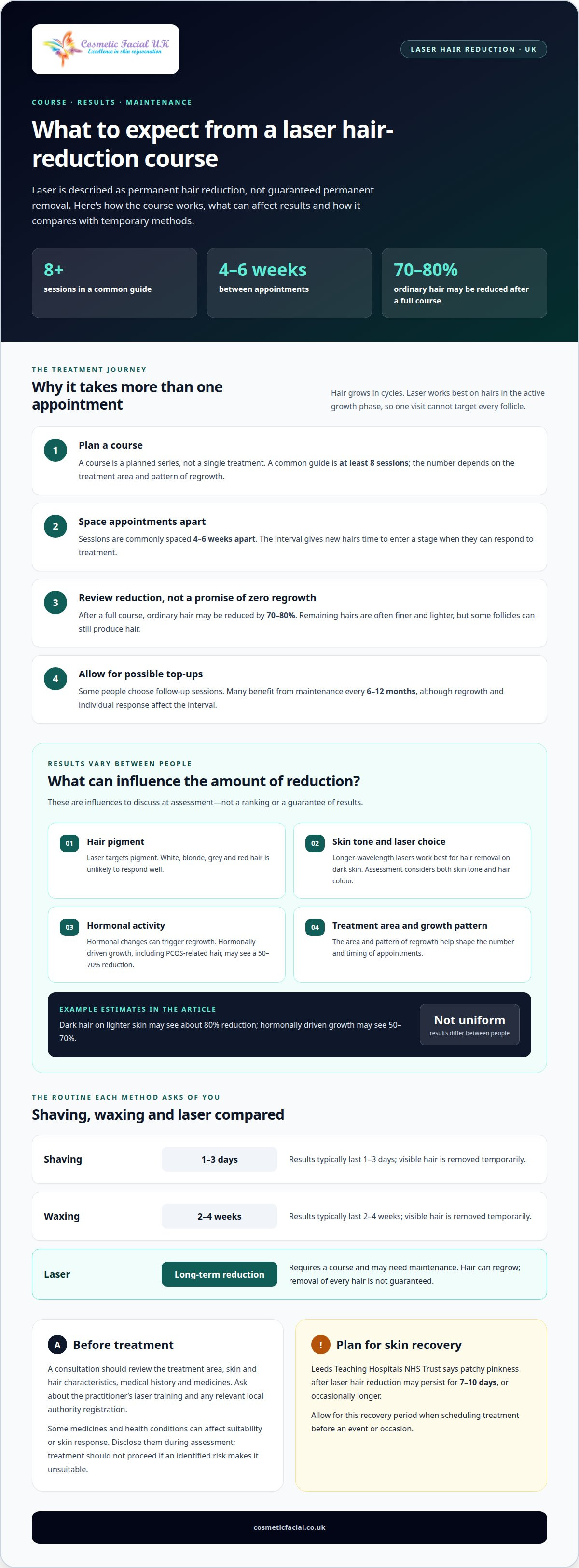
A course is a planned series of laser sessions, not a single treatment. A common guide is at least eight sessions, spaced four to six weeks apart. The interval gives new hair time to enter a stage when it can respond to treatment. The number and timing of appointments depend on the area and pattern of regrowth.
Hair growth cycles and treatment timing
Hair growth cycles mean that individual hairs are not all ready for treatment at the same time. Laser works on hair in the active growth phase, so one appointment cannot target every follicle. Repeating treatment at intervals allows more hairs to reach that responsive stage. This explains why several laser treatments are needed, even when the area seems to have little visible growth between sessions.
Hair and skin colour also affect how well treatment works. Laser is most effective when hair has enough pigment to absorb its light; white, blonde, grey and red hair is unlikely to respond well. Longer-wavelength lasers work best for hair removal on dark skin. An assessment considers hair colour, skin tone and the treatment area when planning treatment.
After a full course, ordinary hair may be reduced by 70-80%, with remaining hairs often finer and lighter. The question of whether laser hair removal is permanent in the UK therefore depends on what you mean by permanent: reduction can last, but not every hair is removed. Hormonal changes and the treated area can influence regrowth, and some people choose follow-up sessions.
Before treatment, a consultation should review the treatment area, skin and hair characteristics, medical history and medicines. In the UK, ask about the practitioner’s laser training and any relevant local authority registration. Some medicines and health conditions can affect suitability or skin response, so disclose them during assessment. Treatment should not proceed if an identified risk makes it unsuitable.
Temporary skin reactions can also affect your plans. Leeds Teaching Hospitals NHS Trust says patchy pinkness after laser hair reduction may persist for 7 to 10 days or occasionally longer. Allow for this recovery period when scheduling treatment before an event or occasion.
Is permanent hair reduction worth it compared with shaving forever?
Laser aims to reduce unwanted hair over the long term, while shaving and waxing remove visible hair temporarily. Whether that trade-off suits you depends on your expectations, skin and hair characteristics, and willingness to maintain results.
Reduction compared with permanent removal
Permanent hair reduction means fewer hairs grow back; permanent removal would mean no regrowth from the treated follicles. Laser can permanently remove some hair, but other hairs may return over time. A lasting reduction can still leave visible hair to manage. In UK advertising, laser treatment is described as permanent hair reduction, not guaranteed permanent removal.
Expected reduction and lasting results
For dark hair on lighter skin, laser may reduce hair by about 80%; hormonally driven growth, including PCOS-related hair, may see a 50-70% reduction. These estimates illustrate why results differ between people. Hair pigment, skin tone and hormonal activity influence how much hair responds, so the outcome is not necessarily uniform across one treatment area.
Some hair follicles may be permanently affected, while others can still produce hair. Changing hormone levels can trigger regrowth, even after an initially successful course. The practical result may be a marked reduction in hair density rather than completely smooth skin. This difference matters if your priority is removing every visible hair.
Ongoing maintenance after treatment
Maintenance sessions treat hair that becomes visible again after the initial course. Many people benefit from top-ups every 6 to 12 months, although the interval depends on regrowth and individual response. Hormonal changes can alter the pattern, so maintenance is better viewed as occasional follow-up than as a fixed schedule for everyone.
Consider whether you’re comfortable returning for treatment if new growth appears. Someone treating a small area may have different priorities from someone managing several areas. A realistic plan allows for both the initial reduction and possible future sessions, rather than assuming the first course will end all hair management.
Weighing up whether reduction is worthwhile
Laser may suit someone who wants longer-lasting reduction and less frequent hair removal. Shaving results typically last 1-3 days, while waxing results last 2-4 weeks. By comparison, laser targets hair follicles to reduce future growth, but involves a course and may require maintenance. The relevant comparison is the routine each method asks of you.
Think about your main concern: frequent shaving, visible regrowth, or irritation after hair removal. Your hair colour and hormonal pattern also affect likely results. For example, someone with dark hair may respond differently from someone with white, blonde, grey or red hair. A discussion of hair reduction options can help you consider these factors against your expectations.
How laser hair removal works
Laser hair removal uses concentrated light to target pigment in the hair. The light is absorbed by the pigmented hair shaft and converted into heat, damaging the follicle and reducing its ability to produce hair. The aim is to affect the follicle while limiting heat exposure to surrounding skin. Hair with more pigment absorbs the light more effectively.
The follicle responds best when its hair is actively growing and still connected to the root. Because hairs in one area grow at different stages, a single treatment cannot affect every follicle equally. Treated hairs don’t disappear immediately; they shed over 1-3 weeks. This gradual shedding can make the area appear unchanged for a short period, even after the follicles have been treated.
Skin tone also matters because the device’s light can interact with pigment in the skin as well as the hair. Longer-wavelength lasers work best for hair removal on dark skin. The laser type and settings therefore need to suit the treatment area, hair and skin tone. A suitable approach balances effective targeting with protecting the surrounding skin.
How IPL differs from laser
Intense pulsed light, or IPL, uses pulses of light rather than the concentrated beam produced by a laser. Like laser treatment, IPL targets pigment in the hair, so hair colour and skin tone influence how well it works. The methods deliver light differently, but both aim to reduce growth by acting on pigmented hairs.
IPL treatment is usually delivered as a course, with the timing adjusted to hair growth. After the initial IPL treatment stage, sessions can be repeated every 1-2 months, depending on growth. This interval allows new hair to become visible before another session. IPL and laser should not be treated as interchangeable names for the same technology.
How electrolysis works
Electrolysis takes a different approach: it treats individual follicles rather than using light to target pigmented hair across an area. A fine probe delivers electrical energy into a follicle, damaging it so it can no longer produce hair. Because it works follicle by follicle, treatment is more targeted than light-based methods and may take longer over larger areas.
Electrolysis does not target hair pigment, so it can be an option for hair colours that respond poorly to laser or IPL. Electrolysis is commonly associated with permanent hair removal, while laser treatment is usually described as hair reduction. That distinction matters if your priority is permanent removal rather than long-term reduction. A destroyed follicle cannot produce another hair, although untreated follicles can still contribute to growth.
Laser hair removal compared with shaving and waxing
Shaving cuts hair at the skin’s surface, while waxing removes visible hairs from their roots. Laser and IPL use light to reduce future growth, whereas electrolysis treats follicles individually.
The main differences are how long results last and what maintenance involves. Shaving requires repeated surface removal as hair grows; waxing removes hairs temporarily and requires regrowth before another appointment. Laser aims to reduce hair growth over a course of treatments, while electrolysis works follicle by follicle. Your choice depends on whether you prefer a familiar short-term routine or a longer treatment process.
Laser treatment requires hair roots to remain present, so waxing, tweezing and epilation are unsuitable between sessions. Shaving does not remove the root in the same way, making it a more compatible temporary method during a laser course. Removing a hair from its follicle can leave less of a target for the next laser appointment.
Laser and IPL both use light absorbed by hair pigment, but they are different technologies. Laser uses a concentrated beam; IPL delivers pulses of light. Hair colour and skin tone affect how well light-based treatments work. Electrolysis, by contrast, does not depend on hair pigment because it treats individual follicles directly. These differences matter for blonde, grey, red or white hair, which is unlikely to respond well to laser.
Electrolysis may suit someone focused on individual hairs or hair with little pigment, while laser can treat a broader area. The trade-off is the method: electrolysis works follicle by follicle, whereas light-based treatments target pigmented hair across an area. Neither approach suits everyone; hair and skin characteristics help determine the choice.
Sun exposure is another practical consideration during laser treatment. Avoid sunbathing, sunbeds and tanning products while undergoing treatment, because exposed or recently tanned skin can affect treatment planning. Shaving and waxing do not use light targeting, but they also do not reduce future hair growth in the same way.
Choose a method based on the outcome you want and the routine you can maintain. Shaving may be convenient for quick surface removal, while waxing suits someone comfortable waiting for regrowth between appointments. Laser involves a course and may need follow-up treatment; electrolysis requires repeated, targeted work on individual follicles. Comparing these steps helps set realistic expectations for smoothness, regrowth and ongoing hair removal.
Whether laser hair removal is permanent
Laser treatment can provide lasting hair reduction, but it should not be understood as permanent removal of every unwanted hair. A substantial reduction can make hair less visible without ending all future growth. The clearest expectation is reduced growth, with possible regrowth over time.
In the UK, laser is described as permanent hair reduction rather than permanent hair removal. Leeds Teaching Hospitals NHS Trust says laser treatment cannot completely remove hair. Some treated follicles may stop producing hair permanently, while others can still produce regrowth. A course changes the amount of hair rather than reliably eliminating every follicle in the area.
Permanent hair removal has a narrower meaning: hair from a destroyed follicle is permanently removed. Only electrolysis can legally claim true permanent hair removal. Unlike light-based methods, electrolysis treats individual follicles, so its approach differs from laser’s broader reduction of hair growth. The method matters if your priority is complete removal rather than fewer or finer hairs.
The lasting effect of laser depends partly on which follicles respond during treatment. Laser works on hairs in an active growth cycle, so a course cannot affect every hair at once. This helps explain why some growth may remain. Hormonal changes can also trigger regrowth, including after a period of reduced hair.
Expected results differ with skin tone and hair colour. For dark hair on darker skin treated with the right laser, hair reduction is estimated at about 75%. That figure describes reduction, not total removal. It also makes clear why a single percentage cannot promise the same result for every person or body area.
It helps to distinguish treatment success from permanence. If fewer hairs grow back and the remaining hair is finer, the procedure may still have achieved a meaningful reduction. But someone expecting completely smooth skin indefinitely may find that expectation unrealistic. Occasional maintenance can address renewed visible growth, particularly when hormone levels change.
Match your expectations to the outcome you value most. If your aim is less frequent hair management, reduction may meet that goal even if some hair regrows. If you want permanent removal of each hair, laser cannot make that claim. Judge laser by sustained reduction, not complete elimination.
Cosmetic Facial
Cosmetic Facial offers laser therapies and IPL Hair Removal Treatment for people considering longer-term hair reduction in London. If you’re weighing treatment against shaving or waxing, a personalised discussion can clarify your goals, hair and skin characteristics, and the difference between reduction and permanent removal.
This discussion can help before you choose a course or if you’re unsure whether laser or IPL better suits your needs. Cosmetic Facial’s qualified specialists provide personalised care, helping you understand the treatment options relevant to your concerns without promising complete or permanent removal.
Contact Cosmetic Facial to discuss your hair-removal goals and next steps.
Choose a treatment plan that fits your goals
Deciding whether laser hair removal is permanent in the UK starts with being clear about the result you want. Consider how much reduction would make a practical difference, how you feel about possible regrowth, and whether occasional follow-up treatment fits your routine. These priorities can guide a focused discussion about suitable options.
Cosmetic Facial in London can discuss your hair-removal goals and treatment considerations. Its services include IPL Hair Removal Treatment, alongside Botox Treatment and HIFU Face Lift for other aesthetic concerns. Talk through the outcome you’re seeking and the factors that may affect your treatment choices.
With clear expectations, you can make an informed decision that feels right for you.
Frequently Asked Questions
Does skin or hair colour make a difference?
Yes. Hair needs sufficient pigment to absorb treatment light, so white, blonde, grey and red hair is unlikely to respond well. Skin tone also affects treatment selection; longer-wavelength lasers work best for hair removal on dark skin. For example, someone with dark hair and a deeper skin tone needs a different laser approach from someone with lighter skin. An assessment considers both hair and skin characteristics.
How many sessions before the results are permanent?
No number of sessions makes complete, permanent removal of every hair a reliable expectation. A course commonly involves six to eight treatments, but the result is reduction, not a promise of no future growth. New hairs may become noticeable after treatment, and a clinician can assess whether they represent regrowth or follicles that did not respond. This distinction helps set realistic expectations before deciding whether further treatment is useful.
So, is it worth it?
It may be worthwhile if reducing how often you remove hair matters more than eliminating every hair. Consider the course, the area involved and whether you would accept occasional follow-up. For example, someone troubled by repeated shaving in one area may value lasting reduction, while someone seeking immediate hair removal for an event may prefer a temporary method. The right choice depends on the outcome you value.
What are the side effects?
Temporary redness, swelling, discomfort or irritation can occur after treatment. Leeds Teaching Hospitals NHS Trust says patchy pinkness may persist for 7 to 10 days or occasionally longer. Sun exposure can irritate treated skin and increase the risk of blisters or scarring, so protecting the area matters. If blistering, scabbing or a persistent skin change develops, seek clinical advice rather than treating the area further yourself.
Is laser hair removal permanent or does hair grow back?
Laser provides long-term hair reduction, but some hair can grow back. The procedure may permanently affect some follicles, while others can continue producing hair or become active later. For instance, changes in hormone levels can prompt new growth after a period of reduced hair. It is more accurate to expect less hair than to assume the treated area will remain completely hair-free.
How much hair reduction can laser hair removal achieve long term?
The degree of reduction varies with the treatment area, hair pigment and hormonal influences. Leeds Teaching Hospitals NHS Trust says people may expect an average reduction of up to two thirds in hair growth. This is an average, not a prediction for an individual. Assessing changes in density and regrowth over time gives a more useful picture than judging the result immediately after one appointment.
How many laser hair removal sessions are usually needed and how far apart?
A typical course involves six to eight sessions, with appointments usually several weeks apart. The interval allows different hairs to reach a responsive growth stage before the next treatment. The area and pattern of growth affect the schedule, so appointments may not follow an identical timetable for everyone. A course is planned around the treatment area and the response between sessions.
How much does laser hair removal cost in the UK by treatment area?
The cost depends on the case and is provided after a quote request. The treatment area and number of sessions required affect the overall cost, so a small area and a larger area may need different plans. Cosmetic Facial offers laser therapies and IPL Hair Removal Treatment in London. Discussing the area you want treated and your goals helps clarify the relevant treatment plan before you consider the cost.
Disclaimer
All content on cosmetic Facial website, including blogs, graphics, logos, images, and software, is the property of CosmeticFacial UK or its content suppliers and is protected by applicable copyright laws. Unauthorized use, reproduction, distribution, or modification of any content without prior written permission is strictly prohibited.


