


Surgical blepharoplasty is no longer the sole pathway to correcting heavy, hooded eyelids. For many, the prospect of general anaesthesia and potential scarring is a significant deterrent, even when the physical weight of sagging skin begins to impact their confidence. You've likely noticed that heavy folds make your eyes appear tired or make it nearly impossible to apply eyeliner with precision. Seeking a plasma pen treatment for hooded eyes London at a clinical level ensures that you address these concerns through controlled, medical-grade technology rather than invasive measures.
This guide provides a comprehensive clinical overview of how plasma technology creates a noticeable lift in the upper eyelid. We'll explore the science behind the procedure, the necessary recovery protocols, and the results achieved at our Marylebone clinic. By understanding the mechanism of skin contraction, you can discover how to restore a brighter, more youthful appearance while avoiding the unnatural, over-tightened look of traditional surgery.
Key Takeaways
- Understand the mechanism of sublimation, where plasma energy induces immediate contraction of excess eyelid skin to address dermatochalasis without surgical intervention.
- Compare the clinical benefits of this "no-cut" procedure against traditional blepharoplasty, focusing on the use of high-strength topical anaesthetic and reduced downtime.
- Explore the safety protocols and dermatological oversight provided during a plasma pen treatment for hooded eyes london at our Marylebone clinic.
- Identify the specific stages of the treatment journey, from the initial clinical skin analysis to the long-term stimulation of new collagen fibres.
- Learn why practitioner expertise, such as that of GMC-registered Dr Faramarz Didar, is critical for achieving precise, symmetrical results and avoiding common procedural risks.
Understanding Hooded Eyes and the Role of Plasma Technology
Hooded eyes, clinically referred to as dermatochalasis, occur when excess skin on the upper eyelid folds down over the natural crease. This condition is primarily driven by the biological depletion of collagen and elastin as we age. These proteins provide the structural framework for the dermis; once they diminish, the skin loses its resilience and begins to sag under gravity. This leads to a heavy appearance that can make individuals look prematurely aged or fatigued.
A plasma pen treatment for hooded eyes london offers a precise, non-surgical intervention for this concern. Unlike traditional blepharoplasty, which involves surgical excision of tissue, plasma technology utilises The Science of Sublimation to contract the skin surface. This process involves converting solid tissue into gas instantly, which triggers a tightening response in the surrounding area. It targets skin laxity specifically. It doesn't address underlying fat pads or muscle, making it a focused tool for surface-level tightening rather than structural reconstruction.
To better understand this concept, watch this helpful video demonstrating the effects of plasma technology on the eye area:
The Anatomy of an Eyelid Lift
The periorbital area contains the thinnest skin on the human body, often measuring less than 0.5mm in thickness. This delicacy makes it exceptionally susceptible to early signs of photoageing and chronological sagging. When skin redundancy becomes significant, it doesn't just alter one's aesthetic appearance; it can physically weigh down the lid and potentially restrict the superior field of vision. At our Marylebone clinic, we prioritise a medical-led approach to these facial rejuvenation treatments. Because the eye area is so intricate, having a practitioner with a deep understanding of facial anatomy is essential for safety and ensuring symmetrical outcomes.
Who is a Candidate for Plasma Eye Resurfacing?
This treatment is most effective for individuals with mild to moderate skin laxity who wish to avoid the risks associated with general anaesthesia or permanent surgical scarring. A plasma pen treatment for hooded eyes london is particularly suitable for those in the early stages of eyelid drooping. Patient selection is a rigorous clinical process. We evaluate candidates based on the Fitzpatrick scale to ensure the skin can heal without complications. While plasma is versatile, certain darker skin types require a more cautious, specialised protocol to prevent post-inflammatory hyperpigmentation. If a patient presents with severe dermatochalasis or significant fat herniation, we may advise that traditional surgical options remain the most appropriate route for their specific anatomical needs.
The Science of Sublimation: How Plasma Fibroblasting Works
Plasma is the fourth state of matter used for skin tightening. This technology functions by ionising atmospheric gases, primarily nitrogen and oxygen, to create a small electrical arc between the device tip and the skin surface. When this arc makes contact, it performs the process of sublimation. Sublimation is the physical transition where a solid is converted directly into a gas without passing through a liquid phase. In a plasma pen treatment for hooded eyes london, this allows for the precise removal of redundant skin tissue without the need for surgical incisions or sutures.
The application of this energy creates a controlled micro-trauma on the epidermis. This stimulus is highly localised and triggers the body's natural wound-healing cascade. Whilst an immediate contraction of the skin fibres is often visible during the procedure, providing an instant lifting effect, the most profound changes occur through dermal remodelling. This biological response ensures that the skin doesn't just tighten superficially but undergoes a structural improvement from within.
Collagen and Elastin Production
Fibroblasts are the specialised cells in the dermis responsible for the synthesis of the extracellular matrix and collagen. The thermal energy from the plasma arc activates these fibroblasts, leading to an increase in the production of Type III collagen. Over the subsequent weeks, this initial collagen is replaced by Type I collagen, which is denser and provides superior structural integrity. This conversion process is why clinical results continue to improve for up to 12 weeks post-treatment. Understanding this timeline is essential for patients at our Marylebone clinic who are monitoring their progress during the recovery phase.
The Precision of the Plasma Arc
The safety of this procedure relies on the extreme precision of the plasma arc. Because the energy is delivered in a non-contact manner, it avoids damaging the deeper dermal layers or the sensitive surrounding ocular tissues. Controlled energy delivery is paramount to prevent potential health risks such as scarring or permanent pigmentary changes. A clinical expert manages the depth and intensity of each arc to ensure the thermal effect remains confined to the target area. This level of accuracy makes a plasma pen treatment for hooded eyes london a viable alternative for those seeking a medical-grade lift with minimal intervention.
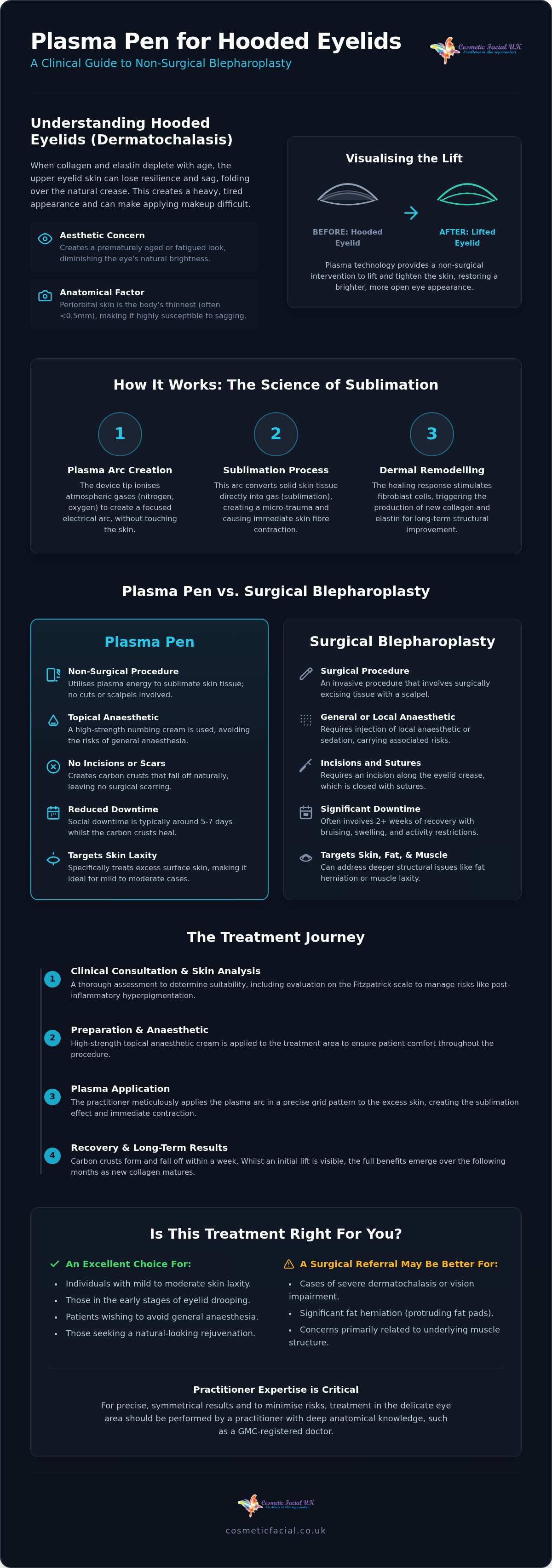
Plasma Pen vs. Surgical Blepharoplasty: A Comparison
Surgical blepharoplasty remains a standard for severe tissue redundancy, yet it involves invasive excision and the inherent risks of general anaesthesia. A plasma pen treatment for hooded eyes london provides a clinical alternative that avoids the scalpel entirely. By using atmospheric plasma to contract the skin, we achieve a noticeable lift without the need for incisions or sutures. This "no-cut" approach is particularly suitable for those who are cautious about permanent surgical alterations or the potential for visible scarring on the delicate periorbital tissue.
The patient experience differs significantly between these two modalities. Surgery requires a hospital setting and a recovery period that often spans several weeks, involving significant swelling and bruising. In contrast, plasma treatment is performed in our Marylebone clinic using high-strength topical anaesthetic. Patients remain alert throughout the procedure, which eliminates the physiological stress associated with being put to sleep. While surgery offers permanent tissue removal, plasma provides durable tightening that can last for several years, depending on the individual's rate of ageing and skin quality.
Choosing Between Non-Surgical and Surgical Options
Selecting the correct modality depends on the patient's age and the specific degree of skin laxity. For individuals with mild to moderate hoodedness, plasma sessions offer a more controlled and gradual improvement. This prevents the "startled" appearance that can sometimes result from over-resection during surgery. Financially, the investment in plasma treatments is often more accessible than the one-off costs of private surgical suites and anaesthetist fees. It's a practical choice for those who cannot commit to a fortnight of post-operative downtime but still require medical-grade results.
Alternative Non-Surgical Eye Lifts
It's useful to distinguish plasma technology from other non-invasive options. For example, a Botox brow lift works by relaxing the depressor muscles to allow the brow to sit higher, whereas plasma actually reduces the surface area of the eyelid skin itself. High-Intensity Focused Ultrasound (HIFU) is another alternative, though it's typically better suited for lifting deeper structures rather than the fine, thin skin of the upper lid. Many patients choose to integrate these procedures into a broader facial rejuvenation plan to ensure the lifted eye area is complemented by improved skin texture across the entire face.
The Treatment Journey: What to Expect in London
The clinical process begins at our CQC-registered facility in Marylebone. Every plasma pen treatment for hooded eyes london commences with a rigorous dermatological consultation led by Dr Faramarz Didar. This initial stage involves a microscopic skin analysis to assess the health of the dermis and the precise pattern of skin redundancy. We take this time to discuss your medical history and set realistic expectations for the lifting effect based on your unique anatomy. This methodical approach ensures that the procedure is tailored to your specific physiological needs.
Following the consultation, we prepare the periorbital area by applying a high-strength, medical-grade topical anaesthetic. This ensures that the sublimation process is as comfortable as possible. The procedure involves the delivery of the plasma arc in a strategic grid pattern across the hooded portion of the lid. This creates the signature "carbon crust" dots, which are tiny points of superficial carbonisation. These dots act as a biological dressing whilst the tissue beneath undergoes immediate contraction. To conclude the session, a cooling, anti-inflammatory serum is applied to soothe the treated area and initiate the healing cascade.
Day-by-Day Recovery Guide
Post-treatment recovery follows a standard clinical timeline. During Days 1 to 3, you'll likely experience localised oedema, particularly in the mornings. This is a natural inflammatory response to the thermal micro-trauma. Between Days 4 and 7, the carbon crusts begin to desiccate and naturally shed. It's imperative that you don't pick or manually remove these crusts, as doing so can disrupt the re-epithelialisation process and lead to permanent scarring. From Week 2 onwards, the initial redness transitions into a light pink hue. This indicates the presence of young, collagen-rich skin that will continue to strengthen over the coming months.
Essential Aftercare for Optimal Results
The success of the treatment depends heavily on strict adherence to aftercare protocols. The most critical requirement is the daily application of broad-spectrum SPF 50. The treated skin is highly vulnerable to UV-induced hyperpigmentation for up to twelve weeks. We also recommend a minimalist skincare routine, avoiding active ingredients like retinoids or exfoliating acids whilst the delicate eye area heals. Using only clinic-approved hydrating serums ensures the barrier function is restored without irritation. For detailed guidance on specific post-procedural concerns, please refer to our frequently asked questions.
Specialist Plasma Eye Treatments at Cosmetic Facial Marylebone
Cosmetic Facial provides a high-specification medical environment for patients seeking a plasma pen treatment for hooded eyes london. Our facility is situated in Marylebone, a district synonymous with clinical excellence and specialist healthcare. The clinic is fully CQC-registered, which means our procedural standards, hygiene protocols, and patient safety measures are subject to rigorous national oversight. This clinical framework is essential for treatments involving the delicate periorbital area, where precision and safety are the primary objectives.
Dr Faramarz Didar (GMC 5200505) leads the practice with a focus on dermatological integrity. He holds an MSc in Dermatology Skills and Treatment with Commendation, providing a level of academic insight that is rare in the aesthetics industry. This specialised background allows Dr Didar to assess skin pathology and wound-healing capacity with medical accuracy. We don't apply generic treatment patterns; instead, we create bespoke plans tailored to the specific eyelid anatomy and tissue laxity of each individual. This ensures that the lifting effect is both natural and symmetrical.
Why Clinical Expertise Matters for Eye Treatments
The skin surrounding the eyes is exceptionally thin, making it vulnerable to complications if treated incorrectly. Using "beauty-grade" devices in non-clinical settings often leads to inconsistent energy delivery, which increases the risk of post-inflammatory hyperpigmentation or permanent scarring. Dr Didar is a member of the European College of Aesthetic Medicine & Surgery and has undergone extensive training across Europe. This expertise ensures that the plasma arc is delivered at the optimal depth and density required to stimulate fibroblast activity without damaging deeper dermal structures.
Our approach prioritises long-term skin health over temporary cosmetic fixes. By managing the sublimation process with medical-grade precision, we can achieve significant skin contraction whilst minimising the physiological stress on the tissue. This professional oversight is particularly important for patients with complex skin types or those who have previously undergone other facial rejuvenation procedures. We ensure that every stage of the treatment is monitored by a practitioner who understands the histological changes occurring within the dermis.
Visiting Our Marylebone Clinic
Our Marylebone clinic offers a discreet and professional setting for your aesthetic journey. The location is conveniently accessible for clients travelling from across London and the South East, providing a calm sanctuary for clinical care. We believe that aesthetic decisions should be made with a serious-minded approach, supported by thorough information and expert guidance. From the initial consultation to the final review, your care is managed by a GMC-registered doctor dedicated to achieving precise, medical-grade results.
Advancing Your Aesthetic Goals with Clinical Precision
Choosing a plasma pen treatment for hooded eyes london represents a sophisticated commitment to both safety and natural results. This technology offers a medical-grade alternative to invasive surgery by harnessing controlled sublimation to contract redundant eyelid tissue. The process triggers a durable biological response; it ensures that the initial lift is supported by several months of progressive collagen remodelling within the dermis.
Under the expert guidance of Dr Faramarz Didar, a GMC-registered practitioner with an MSc in Dermatology with Commendation, your treatment is managed within a strictly CQC-compliant environment in Marylebone. This clinical rigour is essential for procedures in the delicate periorbital area. Anatomical expertise and precise energy delivery remain paramount to achieving symmetrical, authentic outcomes. By following our structured recovery and aftercare protocols, you can restore a brighter and more youthful appearance without the risks associated with general anaesthesia or surgical scarring.
We look forward to supporting your aesthetic journey with the highest standards of dermatological care and professional reassurance.
Frequently Asked Questions
Is plasma pen treatment for hooded eyes painful?
Discomfort is managed effectively through the application of a high-strength, medical-grade topical anaesthetic before the procedure begins. Most patients report a mild stinging or warm sensation during the sublimation process, but it's significantly more tolerable than surgical alternatives. Dr Didar ensures the anaesthetic has sufficient time to take effect, prioritising patient comfort throughout. Post-treatment, the area may feel sensitive, similar to a mild sunburn, for approximately 24 to 48 hours.
How long do the results of a non-surgical eye lift last?
Results typically remain visible for three to five years, depending on the individual's skin quality and rate of natural ageing. Whilst the skin contraction achieved is durable, the body continues to age chronologically. Factors such as UV exposure, smoking, and genetic predisposition will influence how long the lifting effect is maintained. Many patients at our Marylebone clinic choose to undergo a maintenance session after several years to sustain their rejuvenated appearance and skin density.
Can I wear makeup after a plasma pen treatment?
You must avoid applying any makeup to the treated periorbital area for at least seven to ten days. It's essential that the carbon crusts remain clean and dry to prevent secondary infection or the disruption of the healing tissue beneath. Applying cosmetics can introduce bacteria and interfere with the natural desiccation and shedding process. Once the crusts have fallen off naturally and the new skin is visible, you may resume your usual makeup routine.
How many sessions of plasma fibroblasting will I need for hooded eyes?
Most patients achieve a significant clinical improvement after a single plasma pen treatment for hooded eyes london. However, the total number of sessions required depends on the severity of the skin laxity and the individual's biological response to the thermal stimulus. For those with more pronounced hoodedness, a second session may be recommended twelve weeks after the initial treatment. A personalised assessment during your consultation will determine the most effective plan for your anatomy.
Are there any risks or side effects associated with plasma pen?
Common side effects include temporary oedema, erythema, and the formation of carbon crusts, which are expected physiological responses to the treatment. More significant risks, such as post-inflammatory hyperpigmentation or scarring, are rare when the procedure is performed by a clinical expert like Dr Didar. Adhering to strict aftercare, particularly the daily use of SPF 50, is vital to mitigate these risks. Our CQC-registered environment ensures that all safety and hygiene protocols are rigorously maintained.
What is the difference between Plexr and other plasma pens?
Plexr is a medical-grade device that utilised a specific frequency to ensure sublimation occurs without transferring excessive heat to deeper dermal layers. Many "beauty-grade" pens available in non-clinical settings lack this precision, which can lead to unpredictable thermal damage and scarring. At our London clinic, we prioritise devices that allow for controlled energy delivery. This distinction is critical for patient safety, ensuring the treatment remains superficial and does not cause permanent pigmentary changes or tissue damage.
How soon can I return to work after an eye lift in London?
Most patients return to their professional duties within seven to ten days, once the carbon crusts have naturally shed. Whilst you're physically capable of working immediately, social downtime is usually required due to visible swelling and the presence of the treatment dots. The most significant swelling typically occurs during the first three days post-procedure. If your role allows for remote work, you may feel comfortable resuming your responsibilities sooner, provided you follow all aftercare instructions.
Is plasma pen suitable for dark circles as well as hooded eyes?
Plasma pen technology is primarily designed for skin tightening rather than treating pigmentary or vascular dark circles. Whilst it can improve the texture and thickness of the lower eyelid skin, which might subtly reduce the appearance of shadows, it's not a primary treatment for hyperpigmentation. For dark circles, we often recommend alternative modalities such as dermal fillers or chemical peels. A thorough clinical analysis is necessary to determine the underlying cause of your specific concern before proceeding.
Disclaimer
All content on cosmetic Facial website, including blogs, graphics, logos, images, and software, is the property of CosmeticFacial UK or its content suppliers and is protected by applicable copyright laws. Unauthorized use, reproduction, distribution, or modification of any content without prior written permission is strictly prohibited.


