


Radiofrequency may soften early jowling, but it can’t remove excess tissue. If you’re asking whether can medical RF remove jowls, the distinction matters: improving skin firmness and lifting sagging tissue are not the same thing.
It’s understandable to want a non-surgical option that makes a visible, lasting difference. RF may improve mild to moderate skin laxity, but results vary and are generally more subtle than a surgical lift. It won’t remove loose skin or reposition deeper tissues, so it may not address more pronounced jowling.
This article explains what RF can and can’t change, and compares its aims with HIFU and dermal fillers for lower-face concerns. It also outlines what an assessment should consider, including the likely contributors to jowling, the degree of change you want and your suitability for treatment. Cosmetic Facial offers radiofrequency treatment and other non-surgical facial options at its clinic in Marylebone, London.
Key Takeaways
- Can medical rf remove jowls? Learn why RF may improve skin firmness but cannot remove excess tissue.
- Understand how the cause and degree of jowling can influence whether RF is a suitable option.
- Compare the different aims of RF, HIFU and dermal fillers, and why they are not interchangeable.
- Find out what an assessment, personalised treatment plan and follow-up may involve.
- Use practical decision factors to assess treatment claims and set realistic expectations before considering RF in London.
Can medical RF remove jowls? What treatment can realistically change
Medical radiofrequency (RF) may improve skin firmness, but it doesn’t excise or remove excess tissue. So, can medical RF remove jowls? Not in the sense of removing loose skin or surgically lifting descended tissue. Any change is more accurately described as a possible improvement in skin tightness or lower-face contour. The degree of response varies between people.
Jowling describes fullness or sagging along the lower cheeks beside the jawline. Skin laxity can contribute, but changes in facial volume, support or tissue position may also affect the contour. These factors can overlap, and appearance alone can’t establish which is most responsible in an individual case.
The video below shows a general facial rejuvenation example, not an RF treatment or a guide to expected RF results.
What people mean when they describe jowls
The visible change may be a less defined jawline, with tissue appearing to hang below its previous outline. Mild skin laxity is different from pronounced excess skin or a marked descent of deeper supporting tissues. That distinction matters because a treatment aimed at skin firmness may have limited influence when volume change or tissue position is the main concern. An assessment considers the lower face as a whole, rather than treating the word “jowls” as a diagnosis.
What medical radiofrequency is intended to do
RF devices deliver energy that heats targeted tissue. The depth, temperature and treatment approach depend on the device and protocol. Controlled heating is intended to affect tissue and may support changes associated with collagen remodelling, which could contribute to firmer-looking skin. This overview of radio-frequency skin tightening outlines the proposed mechanism, but it shouldn’t be read as a guarantee of a particular result.
RF skin tightening uses energy to target tissue and may improve firmness; surgical removal excises excess tissue and can reposition structures. These are different treatment aims. RF may offer a modest contour change where laxity is a relevant factor, but it cannot remove skin or reproduce a surgical lifting result. Suitability and likely response depend on individual anatomy, the treatment method and the degree of laxity.
How RF may affect lower-face laxity, and who may be suitable
Whether RF is worth considering depends on what is contributing to the lower-face change, not simply on the presence of jowls. RF is intended to address skin firmness. Its potential effect differs from correcting more pronounced tissue descent or excess skin. An assessment helps establish whether the treatment aim matches your concern and expectations.
How radiofrequency interacts with skin tissue
Radiofrequency delivers energy that creates controlled heating in targeted tissue. Depending on the device and protocol, this is intended to prompt a response associated with collagen remodelling, which may support firmer-looking skin over time. The degree of change is not guaranteed. This proposed process is distinct from immediately removing fat or skin, and should not be described as a predictable lifting effect.
Devices differ in how they deliver energy, and treatment settings and technique matter. Broad claims about RF do not establish what a particular protocol can achieve around the jawline. The treatment plan needs to be considered in relation to the intended tissue target and your anatomy.
When RF may be considered for jowling
A clinical assessment considers skin laxity, facial structure, skin condition, medical history and the result you hope to achieve. If laxity is mild, the discussion may focus on whether a subtle improvement in firmness is a suitable goal. More advanced tissue descent or pronounced excess skin calls for a different conversation, because RF may not address the main cause of the contour change.
Suitability cannot be determined reliably from age, a photograph or one symptom alone. The specific device’s indications and contraindications also need to be considered alongside relevant medical history and skin concerns. These details can affect whether treatment is appropriate, how it should be planned and what limitations to understand beforehand.
If you’re asking, “can medical RF remove jowls?”, the practical point is to distinguish a possible improvement in laxity from correction of tissue descent. An assessment should clarify the treatment objective, the expected degree of change and whether another approach may better match that objective. Cosmetic Facial provides radiofrequency treatment and non-surgical facial aesthetic services in Marylebone, London. Explore Cosmetic Facial’s treatment information to learn more about the clinic’s options.
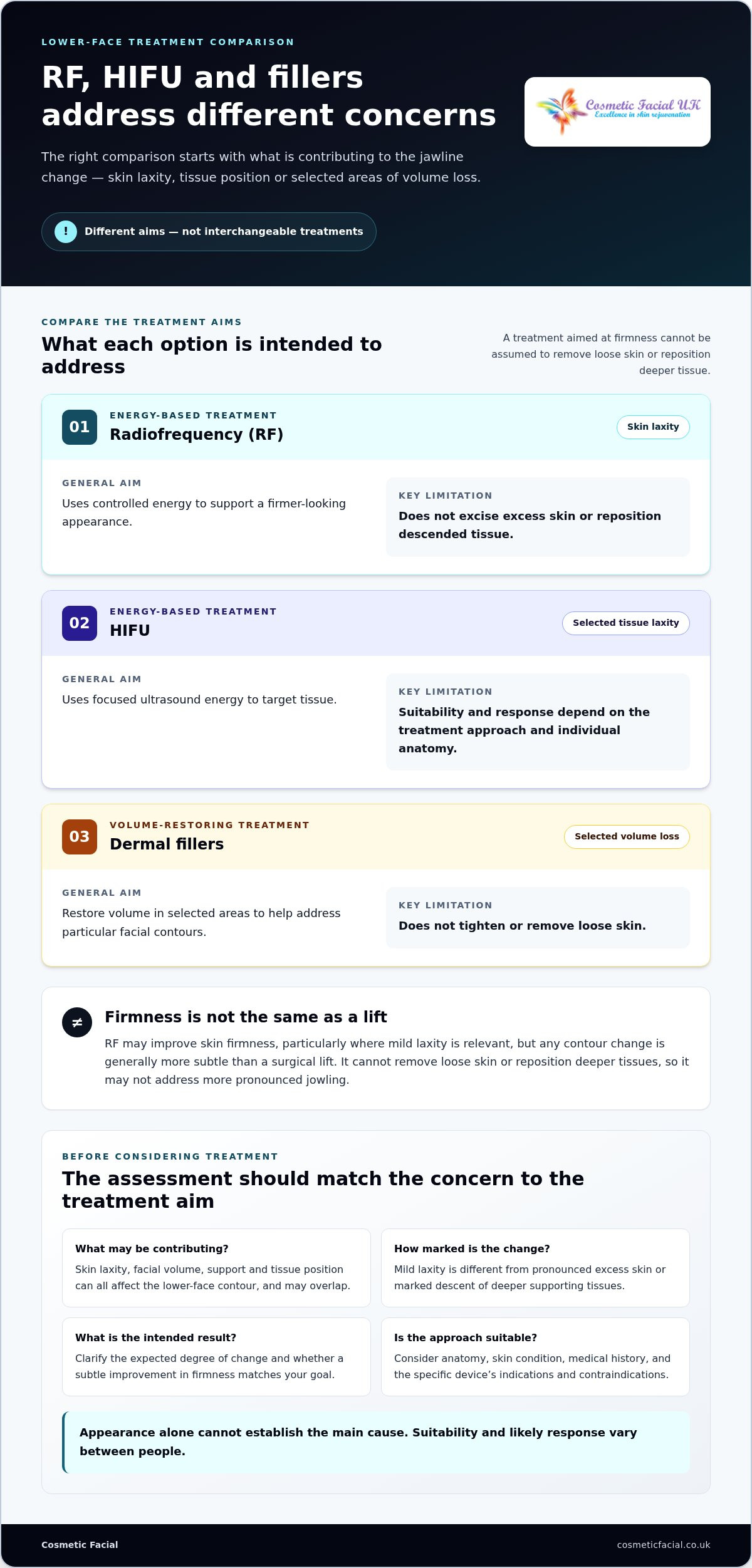
RF, HIFU and fillers for jowls: compare the treatment aims
These treatments address different concerns, so the most suitable option depends on what is affecting the jawline. RF and HIFU are energy-based approaches, whilst dermal fillers are used to restore volume in selected areas. None should be assumed to remove loose skin, and they aren’t interchangeable.
| Treatment | Target concern | General aim | Key limitation |
|---|---|---|---|
| Radiofrequency (RF) | Skin laxity | Use controlled energy to support a firmer-looking appearance | Doesn’t excise excess skin or reposition descended tissue |
| HIFU | Selected concerns involving tissue laxity | Use focused ultrasound energy to target tissue | Suitability and response depend on the treatment approach and individual anatomy |
| Dermal fillers | Selected areas of volume loss | Restore volume to help address particular facial contours | Don’t tighten or remove loose skin |
RF versus HIFU for lower-face laxity
RF uses radiofrequency energy, whilst HIFU uses focused ultrasound. Both are non-surgical treatment categories, but their mechanisms, devices and protocols differ. A comparison should focus on the clinical concern and treatment aim, rather than assuming one is universally more effective. Neither should be presented as a substitute for every other approach to jowling.
For someone asking, “can medical RF remove jowls?”, the relevant distinction is whether the goal is a possible change in skin firmness or a more substantial change in tissue position. An assessment can consider facial structure, degree of laxity and expectations before discussing RF or HIFU. The clinic’s information on non-surgical facelift treatments provides further context about non-surgical options. The key is to consider what concern each treatment is intended to address.
RF versus fillers when facial volume has changed
Where loss of facial volume contributes to a hollow or less supported appearance, dermal fillers may be considered to restore volume in selected areas. This is different from using RF to address skin firmness. Fillers don’t remove loose skin, and adding volume isn’t automatically appropriate for every lower-face concern. The decision depends on anatomy, the location of volume change and your treatment goals.
If there is substantial excess tissue, non-surgical treatments may not achieve the degree of change sought. Surgical procedures are a separate category and can involve tissue removal; for those exploring what surgery entails, dedicated aesthetic plastic surgery practices such as SP Face & Body Specialists illustrate how surgical techniques address laxity and deeper structural descent. A measured discussion of RF, HIFU, fillers and facial rejuvenation helps match the treatment aim to the concern, without treating a device or injectable as a universal solution.
What to expect from medical RF treatment for jowls
RF treatment should follow an individual plan rather than a standard schedule. The process involves more than applying a device to the jawline: assessment, discussion of the treatment aim and follow-up all contribute to an informed decision. Protocols vary, so the number and spacing of sessions, likely response and aftercare depend on the device and clinical assessment.
Consultation and treatment planning in London
At a consultation, the clinician assesses the lower face and skin condition, discusses your medical history and clarifies the degree of change you hope to achieve. This helps distinguish a goal such as modestly improving skin firmness from an expectation of removing excess tissue, which RF cannot do. The clinician can explain whether RF is appropriate to consider, its limitations and relevant alternatives.
Before treatment, discuss the proposed approach, potential risks and device-specific contraindications, and make sure you have time to ask questions and give informed consent. Medical history and current skin concerns matter because they may affect suitability or the treatment plan. Cosmetic Facial is located in Marylebone, London, which can be a practical consideration when planning appointments and follow-up.
Treatment, recovery and follow-up
The treatment should follow the selected device’s protocol. There isn’t a reliable session count or spacing that applies to everyone, and response can’t be guaranteed. The clinician should explain the intended outcome and how progress will be reviewed, so further treatment is considered in light of your response rather than assumed in advance.
Possible temporary effects and downtime are specific to the device and protocol. Rather than relying on general claims about recovery, discuss the effects described in the guidance for the treatment being considered. Follow the clinician’s aftercare instructions, and clarify what to do if you have a concern after treatment. Risks and contraindications also vary, so another person’s experience cannot determine your suitability.
If you’re still weighing up whether can medical RF remove jowls, use the consultation to set a precise goal and understand the limits before deciding. A broader treatment discussion can put RF in context alongside other non-surgical options. Read about facial rejuvenation treatments for further context.
Choosing your next step for RF treatment for jowls in London
Before deciding on RF, consider the degree of laxity, what you want to change and whether your priority is skin firmness, facial volume or a more substantial change in the jawline. Ask yourself whether a limited improvement would meet your expectations, rather than expecting complete correction. These factors are more useful than promotional claims about a device, which cannot predict your individual result.
Questions to clarify before deciding
A clinical discussion should connect the proposed treatment to your specific lower-face concern. Ask what degree of change is realistic, which risks and recovery considerations apply to the device and protocol, and how many sessions may be proposed. Clarify when your response will be reviewed and what the next step would be if RF alone is unlikely to address the concern.
- What is contributing to the appearance of my jowls?
- What result is realistic for my anatomy and degree of laxity?
- What are the relevant risks, aftercare and review plan?
- How would another approach differ in its aim and limitations?
Discussing a personalised treatment plan
A suitable recommendation should reflect your facial anatomy, skin condition, medical history and priorities, not a single symptom or device name. The clinician should explain the reasoning for the proposed option, its limitations and any alternatives, giving you time to consider whether the likely degree of change matches your expectations. It’s reasonable to take time before deciding.
If you’re still asking, “can medical RF remove jowls?”, make that the starting point for a precise conversation about what you mean by “remove” and what change you’re seeking. Cosmetic Facial’s RF and non-surgical facial services in Marylebone, London, can be discussed as part of an individual assessment. The non-surgical facelift overview offers further context on facial options, whilst a clinical appointment can focus on your own concerns.
Explore Cosmetic Facial’s London clinic to learn about its treatments and appointment options.
Make your next step an informed one
Medical RF may support a firmer-looking lower face, but it doesn’t remove excess skin or reposition descended tissue. The question can medical RF remove jowls is best answered by identifying what is contributing to the change and what degree of improvement you hope to achieve. RF, HIFU and dermal fillers have different treatment aims, so an individual clinical assessment is important before choosing between them.
At Cosmetic Facial in Marylebone, London, radiofrequency treatment is available alongside non-surgical facial options. Dr Faramarz Didar’s professional profile includes a postgraduate diploma with merit in non-surgical facial aesthetics and an MSc in Dermatology Skills and Treatment with Commendation. An assessment can help you consider suitability, limitations and realistic expectations in relation to your own concerns.
To discuss your lower-face concerns and the available treatment options, arrange an appointment with Cosmetic Facial in Marylebone, London.
Frequently Asked Questions
Can medical RF remove jowls completely?
No. Medical radiofrequency may improve the appearance of skin firmness, but it doesn’t remove excess skin or reposition descended tissue, so complete correction shouldn’t be expected. Jowling can reflect skin laxity, changes in facial volume, tissue descent or a combination of factors. A clinical assessment can help identify the likely contributors and clarify whether RF’s potential for a modest contour change matches your expectations.
Is radiofrequency effective for mild jowls?
RF may be considered for mild skin laxity, but its effect varies and cannot be guaranteed. It’s more relevant when the treatment goal is a possible improvement in skin firmness, rather than correction of pronounced tissue descent or excess skin. Suitability depends on individual anatomy, skin condition and the device and protocol used. An assessment can establish whether the likely degree of change is worthwhile for you.
How does RF treatment for jowls work?
RF uses energy to create controlled heating in targeted tissue. Depending on the device and protocol, this is intended to encourage a tissue response associated with collagen remodelling, which may contribute to firmer-looking skin. The process doesn’t immediately remove fat or skin, and it shouldn’t be assumed to lift descended tissue. The clinician should explain the specific treatment approach, its intended aim and its limitations before proceeding.
How many RF treatments are needed for jowls?
There isn’t one session number or spacing that applies to everyone. The proposed plan depends on the device protocol, your lower-face anatomy, the degree of laxity and how you respond to treatment. During an assessment, the clinician can discuss the plan and when progress will be reviewed. Further sessions shouldn’t be assumed in advance, and the likely benefit should be weighed against your desired degree of change.
Is RF for jowls painful, and is there downtime?
Sensation and recovery depend on the RF device, settings and treatment protocol, so a general account cannot predict your experience. Ask during your assessment what you may feel, what temporary effects are associated with the specific treatment and whether any downtime is expected. Follow the clinician’s device-specific aftercare instructions. Your skin condition and medical history should also be considered when discussing risks and suitability.
What is better for jowls: RF, HIFU or fillers?
There’s no universally better option because each has a different treatment aim. RF targets skin firmness; HIFU uses focused ultrasound energy for selected tissue-laxity concerns; dermal fillers may restore volume in specific areas. Fillers don’t tighten or remove loose skin, whilst energy-based treatments don’t replace lost volume. A clinical assessment of your anatomy and priorities can help determine which approach, if any, is relevant.
Can RF tighten jowls without surgery?
RF may improve the appearance of skin firmness without surgery, particularly where laxity is mild, but results are variable and generally limited compared with removal of excess tissue or repositioning of descended structures. It cannot provide a surgical lifting result. Cosmetic Facial offers radiofrequency treatment in Marylebone, London, where suitability and realistic treatment aims can be discussed following an individual clinical assessment.
Disclaimer
All content on cosmetic Facial website, including blogs, graphics, logos, images, and software, is the property of CosmeticFacial UK or its content suppliers and is protected by applicable copyright laws. Unauthorized use, reproduction, distribution, or modification of any content without prior written permission is strictly prohibited.


