


A sound botox treatment decision starts with clinical suitability and your goals, not a promised result. If you’re considering treatment in London, it’s reasonable to want clear answers about what it may address, what it cannot, and how potential risks should be discussed before you decide.
A consultation gives you the opportunity to explain your concerns, discuss your medical history and expectations, and have your suitability assessed. At Cosmetic Facial in Marylebone, Dr Faramarz Didar holds an MSc in Dermatology Skills and Treatment, awarded with Commendation, and a postgraduate diploma in non-surgical facial aesthetics for dentists.
This guide explains how botulinum toxin works, which concerns it may help address, and where its limitations lie. It also sets out what to discuss during an assessment, including possible side effects, alternatives and aftercare. Use it to prepare questions and weigh the clinical information carefully before deciding whether treatment is right for you.
Key Takeaways
- Understand how botulinum toxin works and which concerns it may be considered for. It isn’t suitable for every person or goal.
- A botox treatment consultation should cover your health history, expectations, clinical assessment and suitability.
- Before you provide consent, discuss potential benefits, limitations, risks and alternatives.
- Botulinum toxin and dermal fillers work differently. The appropriate option depends on the concern being assessed.
- When choosing a London clinician, consider their relevant qualifications and whether the consultation gives you clear, balanced information. Cosmetic Facial is based in Marylebone.
What does Botox treatment involve, and what concerns can it address?
Botulinum toxin treatment uses a purified neurotoxin to temporarily reduce activity in selected muscles. Botox is a brand name, rather than the name of the treatment itself. A botox treatment may be considered for certain expression-related lines, but it isn’t suitable for every concern or person. Suitability depends on clinical assessment, facial anatomy, health history and the outcome you hope to achieve.
Botulinum toxin is used in medicine as well as aesthetic practice. Its effect on nerve-to-muscle signalling explains how it can alter muscle movement. The Botulinum toxin overview describes its mechanism and wider uses. In aesthetic care, treatment targets specific muscles after an individual assessment. It is not a general solution for every facial line.
How does botulinum toxin treatment work?
Nerves release a chemical messenger called acetylcholine to signal muscles to contract. Botulinum toxin interferes with this signalling at the neuromuscular junction, reducing contraction in the targeted muscle. The change in activity is temporary. This differs from dermal fillers, which add volume beneath the skin rather than reducing muscle movement. The two approaches address different concerns and are not interchangeable.
Which facial concerns may prompt a consultation?
People may seek advice about lines that become more visible with facial expression, such as frown lines between the eyebrows, forehead lines or crow’s feet at the outer corners of the eyes. These examples do not mean treatment is automatically suitable. The clinician needs to consider how your muscles move, your facial features and whether your goals are realistic for this treatment category.
Skin texture, lines visible when your face is at rest, or a desire to restore lost volume may involve different considerations. A consultation can help clarify whether botulinum toxin is relevant, whether another approach may fit better, or whether no treatment is appropriate. For further information about concerns involving facial lines, see our line and wrinkle treatment information.
The same visible line can have different contributing factors, so assessment matters. A useful discussion should identify what concerns you, when it is most noticeable, and what change you are hoping for. That gives the clinician a basis to explain whether the proposed treatment could address the concern and what it would not change.
What happens during a Botox treatment consultation in London?
A consultation should establish what you want to address and whether treatment is clinically appropriate. It should not assume that an injection is the next step. In the UK, botulinum toxin is a prescription-only medicine, so prescribing requires an in-person assessment by an authorised prescriber. The discussion should give you a clear account of the proposed approach and enough information to make a considered decision.
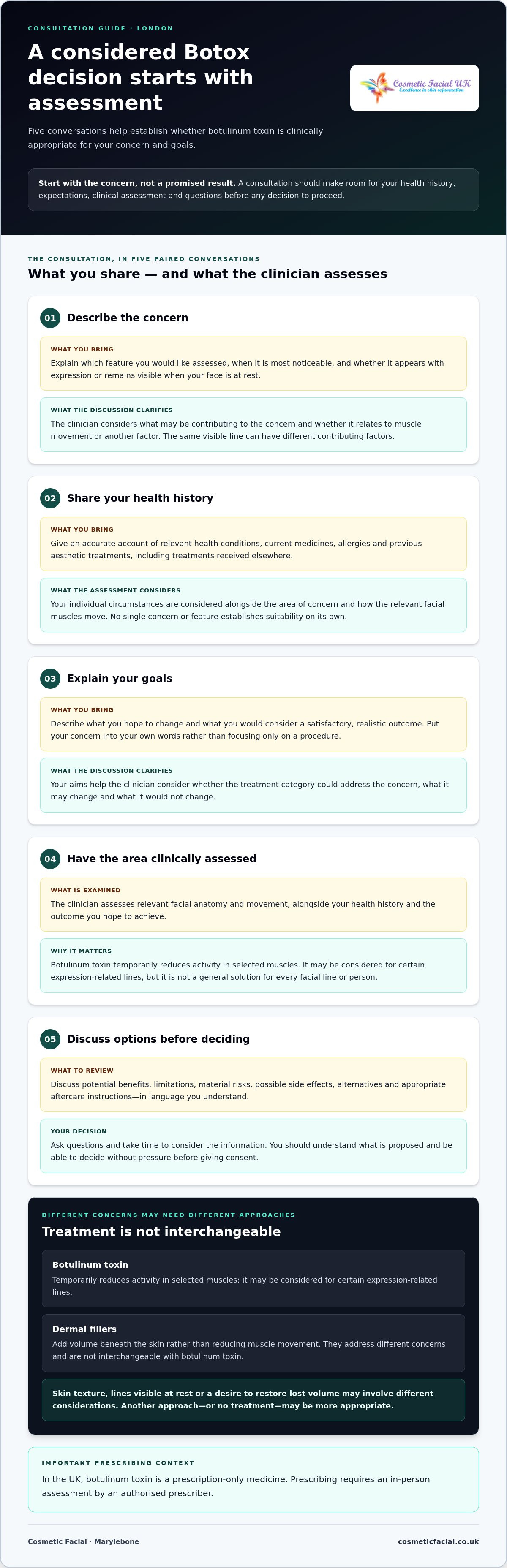
A straightforward consultation usually covers these points:
- Your concern: Describe the feature you would like assessed and when it is most noticeable. For example, explain whether a line appears with expression, remains visible at rest, or changes with different facial movements.
- Your health history: Discuss relevant conditions, medicines, allergies and previous aesthetic treatments. Share the information accurately, including treatments you have had elsewhere.
- Your goals: Explain what you hope to change and what you would consider a satisfactory, realistic outcome. A clear description helps distinguish your main concern from a particular treatment you may already have in mind.
- Clinical assessment: The clinician assesses your facial movement and relevant anatomy, then considers these findings alongside your individual circumstances.
- Discussion and decision: Review potential benefits, limitations, risks and alternatives before deciding whether to proceed. You should have time to ask questions and consider the information.
What information should the clinician assess?
Be prepared to give an accurate account of your health history, current medicines and allergies, alongside any previous aesthetic treatments. The clinician should examine the area of concern and how the relevant muscles move, then consider this alongside your goals. These details inform individual clinical judgement. No single feature or concern can establish suitability on its own.
It can help to describe the concern in your own words rather than focusing only on a procedure. You might explain which feature bothers you, what you notice when your face is moving or at rest, and what you would like to be different. The clinician can then assess whether those aims relate to muscle movement or may involve another factor.
What should be discussed before consent?
Before you consent, the clinician should explain what the treatment may reasonably achieve and where its effects are uncertain or limited. The discussion should cover material risks, possible side effects, alternatives and appropriate aftercare instructions in language you understand. The Mayo Clinic overview of Botox injections also provides general information about the procedure and risks, but it does not replace advice based on your own assessment.
You should have the opportunity to ask questions, consider the information and decide without pressure. Consent is meaningful only when you understand what is proposed and have had your concerns addressed. Before agreeing, make sure you understand which area is being considered, what the intended effect is, what the treatment cannot address, and what alternatives may apply. If treatment is not appropriate, or another option may better match your goals, this should be explained before any treatment is considered.
For more background, read our Botox treatment options in London guide. To enquire about a consultation at Cosmetic Facial, visit the Cosmetic Facial clinic website.
Is Botox treatment right for you, or might another option fit better?
The appropriate option depends on what is causing the concern. A botox treatment works by reducing activity in selected muscles, whereas dermal fillers are used to add volume or support in specific areas. Neither is a universal solution, and they are not interchangeable. An assessment may recommend a different approach or conclude that no treatment is appropriate.
Botulinum toxin treatment versus dermal fillers
This comparison describes broad treatment purposes, not a recommendation. The clinician should assess the concern, your anatomy and your health history before discussing a suitable plan.
| Consideration | Botulinum toxin | Dermal fillers |
|---|---|---|
| General purpose | Temporarily reduces activity in selected muscles, which may be relevant to some expression-related lines. | Adds volume or support, which may be considered for concerns involving facial volume or contour. |
| Assessment | Considers muscle movement, the area of concern, medical history and treatment goals. | Considers facial structure, the area being assessed, medical history and treatment goals. |
| Limitations | Does not restore lost volume or address every type of line. | Does not work by reducing muscle activity and is not suited to every concern. |
Some concerns involve more than one factor, so a simple comparison cannot establish which option is appropriate. The dermal fillers clinical guide offers further context about that treatment category. For general information about potential benefits and risks, see the Mayo Clinic guide to Botox. Individual advice should still be based on a clinical assessment.
When should you discuss alternatives or defer treatment?
Your medical history, medicines, allergies and previous aesthetic treatments may affect the clinician’s assessment. Share this information fully and raise any uncertainty about how a proposed treatment relates to your goals. The clinician should explain whether these factors change the options or mean treatment should be deferred.
For some expression-related concerns, skincare or other non-injectable approaches may be relevant to discuss, although they work differently and may not address the same features. If the concern relates to volume, a filler assessment may be more pertinent. If neither category fits, choosing no treatment is also a valid outcome. The clinician should explain the reasoning, limitations and alternatives without suggesting that one option is automatically superior.
If you’d like to discuss your concern and possible next steps, you can enquire about a consultation at Cosmetic Facial.
What risks, aftercare and realistic expectations should you understand?
Any botox treatment carries potential risks, and the possibility of an unwanted effect should be discussed before you decide. The type and likelihood of effects can vary with the treatment area and individual circumstances. A clinician should explain risks using current, clinically reviewed information rather than presenting the procedure as risk-free.
What risks and side effects should be discussed?
Possible effects can include temporary pain, bruising or swelling around injection sites, headache, and changes such as eyelid drooping or facial asymmetry. These examples are not a complete list, and their relevance depends on the individual treatment plan. Ask which effects apply to your case, what to look out for and how to obtain advice if you are concerned.
The MHRA has warned of rare reports of botulism following botulinum toxin treatment. Symptoms may appear up to four weeks afterwards. Seek immediate medical attention if you develop possible signs such as difficulty swallowing, speaking or breathing, or generalised muscle weakness. The treating clinician should explain the current safety advice and what action to take if symptoms occur.
How can expectations and aftercare be managed?
Agreeing a treatment goal is not the same as guaranteeing a clinical result. The clinician should explain what may be achievable in your circumstances, what the treatment will not address and why the outcome cannot be predicted precisely. Differences in facial anatomy, muscle activity and individual response mean that results vary. This uncertainty should be clear before you consent.
Follow the aftercare instructions provided by your treating clinician, as they should reflect the treatment and your individual circumstances. Generic advice should not replace instructions specific to your care. If you experience an unexpected change or have questions after treatment, use the contact and follow-up guidance provided by the clinic. Seek urgent medical help for symptoms that may indicate a serious reaction.
For further practical information, see Cosmetic Facial frequently asked questions. A careful discussion of risks, aftercare and realistic expectations can help you decide whether proceeding feels appropriate or whether to defer treatment.
Choosing Botox treatment at Cosmetic Facial in Marylebone
Choosing a clinician involves more than considering a treatment name or a hoped-for result. It means discussing your concern, health and goals, and receiving an individual assessment before making a decision. Cosmetic Facial is an aesthetic and medical clinic in Marylebone, London, where you can discuss whether botox treatment is appropriate for your circumstances.
How clinician qualifications support informed care
Dr Faramarz Didar holds an MSc in Dermatology Skills and Treatment, awarded with Commendation in 2015, and completed a postgraduate diploma programme in non-surgical facial aesthetics for dentists in 2013. These qualifications are relevant to his clinical background, but they do not establish that a particular treatment is suitable for every patient or guarantee an outcome.
Professional registration and permitted descriptions are also relevant when reviewing a clinician’s credentials. Current registration details can be checked against the appropriate register and should be described accurately. As a patient, you can ask who will assess you, who is responsible for prescribing where required, and how the proposed care will be managed.
How to take the next step in Marylebone
Before a consultation, consider how to describe the feature that concerns you and what you would like to change. Bring a complete account of relevant health information, medicines, allergies and previous aesthetic treatments. Being clear about your expectations helps the clinician assess whether they are realistic for the treatment being discussed.
At Cosmetic Facial, the consultation is an opportunity to discuss your concern and goals, review relevant health information and assess suitability. The clinician can explain potential benefits and limitations, discuss risks and alternatives, and recommend deferring treatment if that is more appropriate. You should have time to consider the information and decide without pressure.
A considered decision may be to proceed, explore another option or have no treatment. The consultation should help you understand the reasoning, rather than encourage a particular result or imply that treatment is suitable for everyone.
Make an informed decision about your next step
A considered botox treatment decision depends on whether the treatment matches your concern, anatomy and goals. A consultation should clarify potential benefits and limitations, cover relevant risks and alternatives, and give you space to decide without pressure. Outcomes vary, so no particular appearance can be promised.
Cosmetic Facial is based in Marylebone, London, and offers personalised consultations to discuss your circumstances and suitability. Dr Faramarz Didar holds an MSc in Dermatology Skills and Treatment, awarded with Commendation. His qualifications contribute to his clinical background, while an individual assessment determines whether treatment is appropriate for you.
You do not need to decide on treatment before discussing your concerns and options. A consultation can help you understand the available choices and make an informed decision.
Clear information and an individual assessment can help you choose a path that feels right for you.
Frequently Asked Questions
What is Botox treatment, and what is it used for?
Botox is a brand name for a botulinum toxin product. Botulinum toxin treatment temporarily reduces activity in selected muscles. In aesthetic care, it may be considered for some expression-related lines, such as forehead lines or crow’s feet, following an individual assessment. It is also used for certain medical concerns. Appropriate use depends on the indication, a clinician’s judgement and the patient’s circumstances, so suitability and results should not be assumed.
How does a Botox treatment consultation work?
A consultation begins with your concern and goals, then reviews relevant health history, medicines, allergies and previous aesthetic treatments. The clinician assesses the area and facial movement before discussing whether treatment may be suitable. You should receive balanced information about potential benefits, limitations, risks and alternatives, with time to ask questions. Treatment should only be considered after assessment and informed consent, not as an automatic next step.
Is Botox treatment suitable for everyone?
No. Suitability depends on the concern, facial anatomy, medical history, medicines and other individual factors assessed by a qualified clinician. Some people may need to defer treatment or consider another option, while for others no treatment may be appropriate. Be open about your health and expectations during consultation. The clinician should explain the reasoning behind their recommendation and avoid promising a particular appearance or outcome.
Can Botox treatment be compared with dermal fillers?
They have different purposes and mechanisms. Botulinum toxin temporarily reduces activity in selected muscles, which may be relevant to some expression-related lines. Dermal fillers add volume or support in specific areas and may be considered for concerns involving facial volume or contour. Neither option is universally better, and they are not interchangeable. A clinical assessment helps determine which approach, if any, relates to the concern being discussed.
What risks and side effects should I discuss before treatment?
Ask the clinician to explain risks relevant to your proposed treatment and health history. Possible effects include temporary pain, bruising or swelling at injection sites, headache, eyelid drooping or facial asymmetry. Rare reports of botulism have prompted MHRA safety advice. Seek immediate medical attention for difficulty swallowing, speaking or breathing, or generalised muscle weakness, which may occur up to four weeks after treatment. This list is not exhaustive.
What should I expect after a Botox treatment?
Follow the individual aftercare instructions provided by your treating clinician, as advice should reflect your treatment and circumstances. Effects and responses vary, so a specific appearance or result cannot be guaranteed. Ask what changes to expect, which effects should prompt a call to the clinic and how to seek medical advice if you are concerned. For serious symptoms such as difficulty breathing or swallowing, seek immediate medical attention rather than waiting for a routine follow-up.
Where can I have a Botox treatment consultation in Marylebone, London?
Cosmetic Facial is an aesthetic and medical clinic in Marylebone, London, offering consultations to discuss your concern, goals and suitability for treatment. Dr Faramarz Didar holds an MSc in Dermatology Skills and Treatment with Commendation and a postgraduate diploma programme in non-surgical facial aesthetics for dentists. At consultation, you can discuss relevant health information, possible alternatives and limitations before deciding whether to proceed. The clinic serves patients in London and surrounding areas.
Disclaimer
All content on cosmetic Facial website, including blogs, graphics, logos, images, and software, is the property of CosmeticFacial UK or its content suppliers and is protected by applicable copyright laws. Unauthorized use, reproduction, distribution, or modification of any content without prior written permission is strictly prohibited.


