


A popular treatment is not necessarily the right treatment for you. If you’re searching for an “aesthetic clinic london”, it can be difficult to tell which options may suit your concern, especially when you’re also weighing safety, practitioner qualifications and the risk of an over-treated appearance.
A considered choice starts with your concern, relevant medical history and expectations. A clinician can then assess whether treatment is suitable and explain the options, likely limitations and potential risks. This guide covers what to look for in a consultation, how treatments differ and how to prepare for an appointment.
Cosmetic Facial is based in Marylebone, London, and offers personalised appointments across aesthetic and medical skin services. Dr Faramarz Didar’s documented training includes an MSc in Dermatology Skills and Treatment with Commendation from the University of Hertfordshire in 2015, and a postgraduate diploma in non-surgical facial aesthetics from the University of Central Lancashire in 2013. You can book appointments online or by phone. The guidance below can help you decide what to discuss before taking that step.
Key Takeaways
- Match treatment options to your specific concern and clinical assessment, rather than choosing a procedure because it is popular.
- At an aesthetic clinic london, a considered consultation should address your relevant history, suitability, expected benefits, limitations, risks and alternatives.
- Different concerns may call for different approaches, from line and wrinkle treatments to dermal fillers, skin-quality procedures or energy-based treatments.
- Prepare for your appointment by noting your goals, relevant medical history and questions, including those about realistic outcomes, recovery and aftercare.
- Learn how Cosmetic Facial’s Marylebone location, clinical expertise and online or telephone booking can help you consider your next step.
What does a London aesthetic clinic do and who is it for?
An aesthetic clinic offers consultations and treatments for non-surgical cosmetic concerns and skin health. You might seek advice about facial lines, changes in facial volume or uneven skin texture. You may also need a clinical assessment of a skin concern. The right starting point is what you want assessed, not a procedure that happens to be popular.
When comparing an aesthetic clinic london, consider clinical fit alongside practical details such as location and how clearly treatment options are explained. A useful appointment should help you understand which approaches may be relevant, their limitations and whether you need further assessment.
This video offers a brief look at a professional aesthetics clinic setting:
Which concerns might lead someone to an aesthetic clinic?
Concerns often fall into a few broad groups. These examples can help you prepare for a discussion, but they are not recommendations or assurances that a particular treatment is right for you.
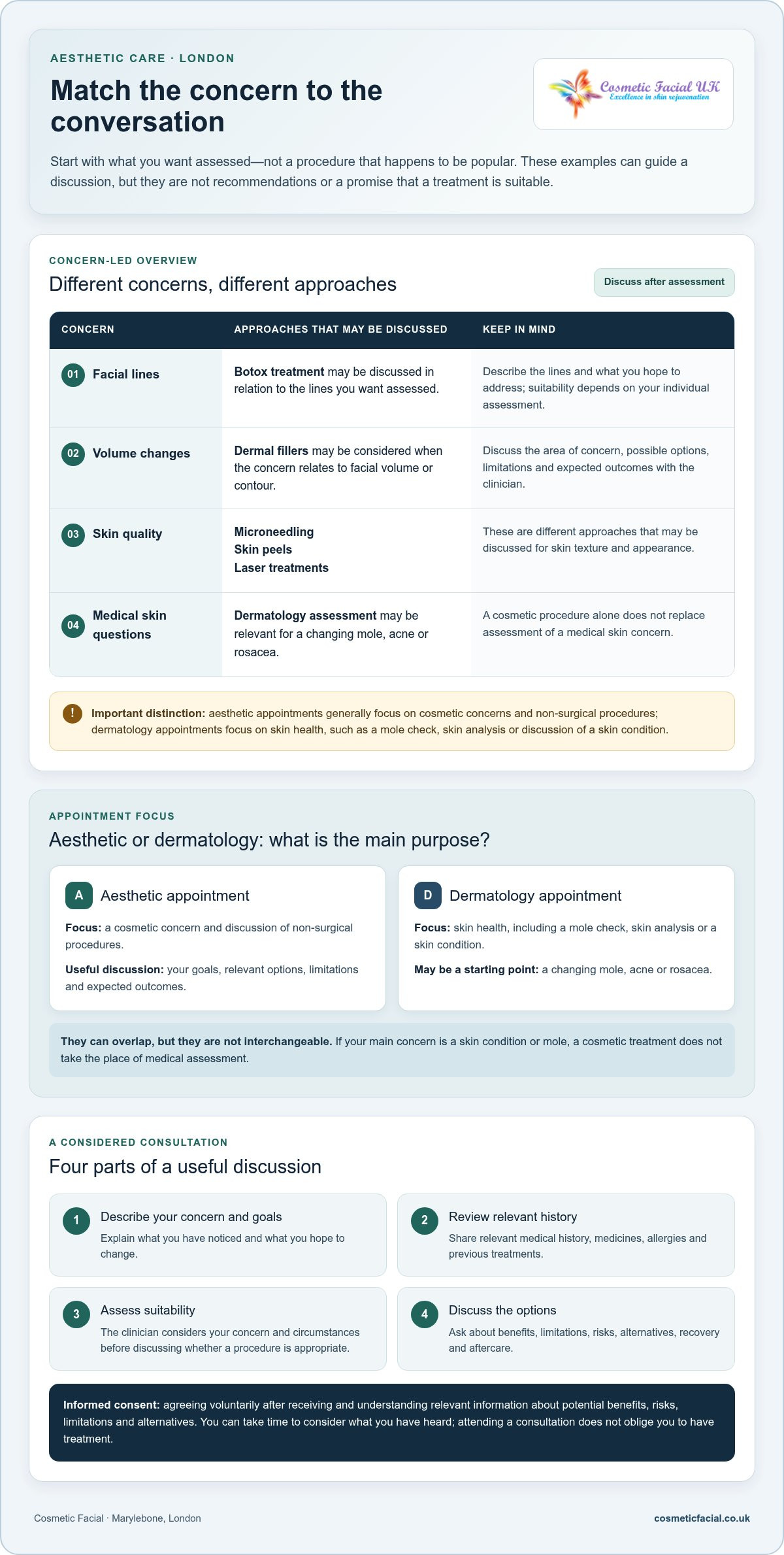
- Facial lines: Botox treatment may be discussed in relation to the lines you want assessed.
- Volume changes: Dermal fillers may be considered when the concern relates to facial volume or contour.
- Skin quality: Microneedling, skin peels and laser treatments are different approaches that may be discussed for skin texture and appearance.
- Medical skin questions: A changing mole, acne or rosacea may need assessment through dermatology services rather than a cosmetic procedure alone.
To make the conversation useful, describe what you have noticed, which area concerns you and what you hope to address. The clinician can assess the issue and discuss relevant options. Avoid deciding on a treatment before that assessment simply because it is trending.
What is the difference between aesthetic and dermatology appointments?
An aesthetic appointment generally focuses on a cosmetic concern and discussion of non-surgical procedures. A dermatology appointment focuses on skin health, for example a mole check, skin analysis or discussion of a skin condition. The areas can overlap, but they are not interchangeable: a cosmetic treatment does not replace assessment of a medical skin concern.
Cosmetic Facial offers dermatology consultations, mole checks and skin analysis alongside aesthetic treatments. If your main concern is a skin condition or a mole, a private dermatologist consultation in London may be a suitable starting point. For a primarily aesthetic concern, explain your goals and ask about the options, limitations and expected outcomes. Being clear about the purpose of your appointment helps keep the discussion focused.
What should you expect from a London aesthetic clinic consultation?
A consultation should give you time to explain your concern and understand the reasoning behind any proposed approach. A search for “aesthetic clinic london” can surface many procedures, but an individual consultation helps establish which, if any, may be appropriate for you. You should be able to ask questions, compare alternatives and decide whether you want to proceed. Attending a consultation does not oblige you to have treatment.
A useful discussion covers these steps:
- Describe your concern and goals. Explain what you have noticed and what you hope to change. Be specific about what a satisfactory result would mean to you.
- Review relevant history. Share relevant medical history, medicines, allergies and previous treatments so the clinician can consider them in context.
- Assess suitability. The clinician considers your concern and circumstances before discussing whether a procedure is appropriate.
- Discuss possible options. Ask about expected benefits, limitations, risks and alternatives, as well as relevant recovery and aftercare information.
Informed consent means agreeing to treatment voluntarily after receiving and understanding relevant information about its potential benefits, risks, limitations and alternatives. You need a clear explanation to weigh those factors. If you feel rushed or need time to consider what you have heard, say so before deciding.
How does a clinician assess treatment suitability?
An assessment connects your goals with your health history and the concern being examined. The clinician may ask what you have tried before and discuss factors that could affect whether a procedure is suitable. Recommendations depend on your individual circumstances; a consultation does not guarantee eligibility, a particular treatment plan or a specific result.
Explain what you want to address, but stay open to alternatives. The clinician may explain that a different approach, further assessment or no procedure is more appropriate. Understanding the reasons behind that advice is part of the value of a consultation, particularly if the treatment you initially had in mind does not match your concern.
Which qualifications help establish clinical expertise?
Consider whether a practitioner’s education and training are relevant to the procedures you want to discuss. Also distinguish dated qualifications from current professional registration, as registration status can change. In the UK, you can check a doctor’s registration through the General Medical Council’s public register.
Dr Faramarz Didar’s documented postgraduate training includes an MSc in Dermatology Skills and Treatment with Commendation from the University of Hertfordshire in 2015, and a Postgraduate Diploma with Merit in Non-Surgical Facial Aesthetics for Dentists from the University of Central Lancashire in 2013. These qualifications describe his education at the time. Consider them in relation to the appointment you need, and check current registration information separately where relevant.
You can review Cosmetic Facial’s clinic and appointment information before deciding on a next step. A good consultation should leave you better informed, whether or not you choose treatment.
How do London aesthetic treatments differ by concern and approach?
Compare treatments by the concern they are intended to address and how they work, rather than by broad labels such as “facial rejuvenation”. Procedures that sound similar in promotional descriptions may use different methods and are not interchangeable. This overview can help you prepare questions for an aesthetic clinic london, but it cannot establish which treatment is right for you.
Use the categories below as a starting point for discussion, not as recommendations. A clinical assessment should establish whether an option, an alternative or no procedure is appropriate for your concern and circumstances.
- Lines and wrinkles: Botox treatment is an injectable approach discussed for certain lines. Its purpose differs from dermal fillers, and suitability depends on individual assessment.
- Facial volume and contour: Dermal fillers may be considered for volume or contour concerns. They are not a substitute for every line-focused treatment, so discuss the proposed area and goal.
- Skin quality and texture: Skin peels and microneedling are skin-focused procedures. They use different approaches, and a clinician can explain their aims, limitations and relevant aftercare.
- Energy-based approaches: HIFU and laser treatments use energy-based technologies, but they are distinct treatment categories. The name alone does not establish whether a procedure suits your concern.
Which options are discussed for lines, facial volume and skin quality?
Start by describing the feature you want assessed, rather than requesting a procedure by name. Botox treatment and dermal fillers address different concerns, so ask about the intended treatment area and the reason for the proposed approach. Read about Botox treatment options in London to understand the line and wrinkle treatment category, then discuss how your concern relates to the available options.
For skin texture or overall skin quality, a consultation may cover options such as skin peels or microneedling. These procedures differ in method and should not be treated as equivalent just because both are described as skin treatments. The discussion should take account of your concern, relevant history and expectations, without promising a particular response.
How should patients compare non-surgical treatment approaches?
Use the same practical questions for each option: what concern is it intended to address, how is it performed, what recovery or aftercare may be relevant, and what does the clinician recommend after assessment? These details vary by procedure and individual. Do not assume that treatments with similar marketing labels have the same method, limitations or recovery considerations.
For example, a filler consultation concerns a different treatment category from an energy-based procedure. Skin-focused options also differ from injectables. If you’re exploring non-surgical facial rejuvenation, use the information to prepare questions rather than selecting a procedure yourself. The assessment should guide whether a treatment, another approach or no procedure is appropriate.
How can you prepare for an aesthetic clinic appointment in London?
A little preparation can make your consultation more focused. Before attending an aesthetic clinic london, note the concern you want to discuss, what you hope to change and what you need to know before making a decision. You don’t need to arrive knowing which procedure you want. A clear description of your priorities gives the clinician a useful starting point for assessment.
Cosmetic Facial is located in Marylebone, London. Before your appointment, consider what information will help the clinician understand your circumstances and what questions you want answered before deciding whether to proceed.
What information should you bring to a consultation?
Be ready to discuss relevant medical history, current medicines and previous aesthetic procedures. Mention any reactions or concerns related to earlier treatments, as these details may inform the assessment. If you’re unsure whether a health detail is relevant, include it in the conversation.
Describe your concern in practical terms. For example, explain which area you want assessed and what kind of change you have in mind, rather than relying only on a treatment name. Writing down questions in advance can help, especially if you want to discuss alternatives or what the consultation can establish.
- Your concern: What you have noticed and the area you would like assessed.
- Your goals: The change you hope for, including what you would consider a realistic improvement.
- Your health information: Relevant medical history, current medicines and previous procedures or reactions.
- Your questions: Anything you want clarified about options, risks, limitations or next steps.
How can you set realistic expectations before treatment?
Distinguish the aim of a treatment from a guaranteed result. A procedure may be discussed for a particular concern, but the consultation should explain its intended purpose, possible limitations and whether it fits your circumstances. Ask what a realistic outcome might involve and how the clinician will assess whether the approach is appropriate for you.
Recovery and aftercare vary by procedure, so ask about the treatment being considered rather than relying on general accounts. Find out what aftercare is recommended, what recovery may involve and whether you may need to adjust your usual routine. You can also review the clinic’s aesthetic treatment frequently asked questions for general information, then raise any personal or unanswered questions at your appointment.
You don’t need to settle every question beforehand. Preparation is about making your priorities clear and supporting a useful discussion, not committing you to a procedure. Cosmetic Facial’s Marylebone clinic offers personalised appointments, with online and telephone booking available.
Why consider Cosmetic Facial as your aesthetic clinic in London?
Cosmetic Facial is an aesthetic and medical skin clinic in Marylebone, London, serving patients from across London and surrounding areas. Its services bring non-surgical aesthetic procedures together with medical skin appointments. That range makes it possible to start with the concern you want assessed rather than assuming one treatment category is the answer. If you’re comparing an aesthetic clinic london, consider whether the clinic offers a relevant route for the kind of concern you have.
Appointments are personalised to the individual. The clinician considers your concern and circumstances before discussing an appropriate approach, its limitations and other relevant options. Treatments on a service menu are possibilities for clinical discussion, not a list of procedures that will suit every patient.
Which aesthetic and skin services are available at Cosmetic Facial?
Aesthetic services include Botox, dermal fillers, HIFU, laser treatments and microneedling. They cover different approaches, from injectable procedures to energy-based and skin-focused treatments. If facial lines are your concern, the clinic’s line and wrinkle treatment information can help you understand the service category before discussing whether it may be suitable.
Medical skin services are a separate part of the clinic’s offering. Dermatology consultations, mole checks and skin analysis provide ways to discuss skin-health concerns, alongside services for concerns such as acne and rosacea. Cosmetic procedures and medical skin assessments have different purposes, so describe the issue you want addressed to help focus the appointment.
Patients may also want to consider documented training. Dr Faramarz Didar earned an MSc in Dermatology Skills and Treatment with Commendation from the University of Hertfordshire in 2015. His documented qualifications also include a Postgraduate Diploma with Merit in Non-Surgical Facial Aesthetics for Dentists from the University of Central Lancashire in 2013. These are educational credentials from specific dates, separate from current professional registration.
What is the next step for a prospective patient?
Before booking, review the information relevant to the treatment or medical skin concern you want to discuss. Note what you would like the clinician to assess and prepare questions about suitability, expected benefits, limitations, risks or aftercare. You can book online or by telephone and use the consultation to discuss your concern in context. Cosmetic Facial’s Marylebone location offers a clear point of reference for patients in London.
A treatment page can help you prepare, but it cannot determine whether a procedure is suitable for you. That decision should follow an individual clinical assessment and an open discussion of your expectations. Explore Cosmetic Facial’s services and booking options when you’re ready to take the next step.
Make your next step an informed one
Choosing an aesthetic clinic london is not about finding the longest treatment menu or following a procedure that is attracting attention. Look for a setting where you can explain your concern and a clinical assessment guides the discussion. Before arranging an appointment, decide what you want to understand, whether that is a treatment’s suitability, its limitations or relevant alternatives.
Use the consultation to consider whether the explanation is clear and whether you feel able to decide without pressure. You can take time to think through the information; treatment does not need to follow simply because you attended. A focused question can be a useful starting point for a more helpful discussion.
Approach the decision at your own pace. A thoughtful next step begins with a clear understanding of what matters to you.
Frequently Asked Questions
Is an aesthetic treatment suitable for everyone?
No. Suitability depends on the individual, the concern being treated, relevant health factors and whether the expected outcome is realistic. A clinician may recommend delaying a procedure or considering an alternative if your medical history or current medicines affect the assessment. Share relevant information fully, including previous treatments and reactions. A consultation can clarify whether a procedure is appropriate, but attending does not mean you have to proceed.
Can Botox be used during pregnancy or breastfeeding?
Botox treatment is generally avoided during pregnancy and breastfeeding because there is not enough safety evidence to establish that it is appropriate in these circumstances. If you are pregnant, breastfeeding or planning a pregnancy, tell the clinician before discussing treatment. Don’t rely on general online advice to make an individual decision. Your GP, midwife or treating clinician can help you consider your circumstances and whether postponing elective treatment is sensible.
How long do Botox results last?
Botox results commonly last around three to four months, although duration varies between individuals and treatment areas. The effect may change gradually rather than ending on a specific date, so avoid planning repeat treatment around a guaranteed timeframe. At your appointment, discuss the change you hope to maintain and when a review might be appropriate. A clinician can advise based on your response and treatment details.
Is there downtime after non-surgical aesthetic treatments?
Downtime depends on the procedure and your individual response, so “non-surgical” does not necessarily mean there are no recovery considerations. Some treatments may involve temporary effects or aftercare that you need to factor into work, social plans or exercise. Before deciding, ask what to expect for the specific procedure, how to manage aftercare and whether any activities should be adjusted. Don’t rely on recovery estimates for a different treatment.
Can different aesthetic treatments be combined?
Sometimes, but combining procedures is not automatically appropriate. The clinician needs to consider the treatments involved, your skin or facial concern, relevant health information and the timing of each procedure. A combination may be discussed as part of an individual plan; in other cases, separate appointments or a single approach may be more suitable. Don’t book several treatments on the assumption that combining them will improve the outcome.
How can I find Cosmetic Facial in London?
Cosmetic Facial is based in Marylebone, London, and serves patients from across London and surrounding areas. If you are comparing options in an aesthetic clinic london search, consider whether the location is practical for your appointment and any recommended follow-up. The clinic’s website provides its location information. Review the details before setting off so you can arrive without rushing into your consultation.
Can I book an appointment online or by phone?
Yes. You can book Cosmetic Facial appointments online or by phone. Before booking, review the information relevant to your concern and note whether you want to discuss an aesthetic treatment or a medical skin question, such as a mole check. This can help you choose a relevant appointment and prepare useful questions. If you’re unsure what to focus on, describe your concern during the appointment rather than choosing a procedure solely by name.
Disclaimer
All content on cosmetic Facial website, including blogs, graphics, logos, images, and software, is the property of CosmeticFacial UK or its content suppliers and is protected by applicable copyright laws. Unauthorized use, reproduction, distribution, or modification of any content without prior written permission is strictly prohibited.


