

PRP therapy for skin rejuvenation in London Bridge uses a person’s own blood: it’s spun to separate the platelet-rich plasma, which is then applied to the skin. A treatment takes 60-75 minutes and includes numbing cream. This process is central to understanding what PRP involves, although suitability depends on more than the treatment method alone.
It’s reasonable to want clear information before deciding whether PRP therapy for skin rejuvenation in London is right for you. This article explains how PRP is prepared and applied, which skin concerns it may address, and what can affect suitability. It also covers aftercare and combining PRP with other treatments, so you can understand the practical steps before considering your options.
Key Takeaways
- Learn how a blood sample is processed to separate platelet-rich plasma and applied during skin rejuvenation.
- Understand which skin concerns PRP may address and the factors that influence whether it may suit you.
- Plan for aftercare, including avoiding heavy makeup for 24 hours after treatment.
- See how a course of 3-4 treatments, spaced 3-4 weeks apart, may fit into a treatment plan.
- Explore how PRP can be considered alongside other treatments, with the approach tailored to your skin goals.
Combining PRP with other treatments
PRP can form part of a wider aesthetic plan, but each treatment has a different purpose. Microneedling creates controlled microchannels in the skin; dermal fillers add volume; PRP uses platelet-rich plasma. Combining treatments may address different concerns, such as texture and volume, but suitability and order depend on the treatment plan. “Regenerative” describes PRP’s intended role in supporting the skin’s natural healing processes, not a guaranteed result.
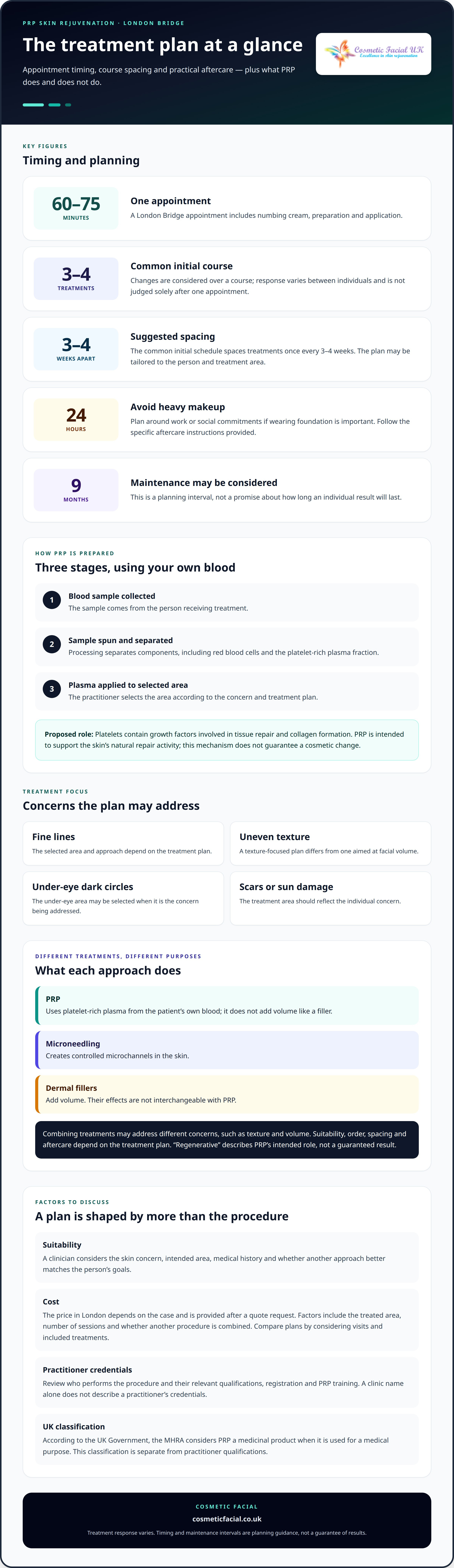
A common initial schedule is 3-4 PRP treatments, spaced once every 3-4 weeks. A maintenance treatment every 9 months may then be considered. These intervals guide planning; they do not establish how long an individual result will last. Changes develop over a course rather than being assessed solely after one appointment, and the response varies between individuals.
In London, the price depends on the case and is provided after a quote request. Factors include the area treated, number of sessions and whether PRP is combined with another procedure. A single facial appointment and a multi-session course are different treatment plans, so compare total costs by considering both the number of visits and the treatments included.
At London Bridge, a PRP skin rejuvenation appointment takes 60-75 minutes and includes numbing cream. The facial may focus on areas such as the under-eyes, where dark circles are a concern, or skin affected by fine lines, scars, sun damage or uneven texture. The treatment area and combination plan should reflect the concern being addressed, rather than assuming every facial covers the same zones.
PRP does not work like a filler, and combining treatments does not make their effects interchangeable. A clinician can plan whether separate procedures belong in the same course, considering the area and intended outcome. For example, a plan focused on skin texture differs from one that also aims to restore facial volume. Appropriate spacing and aftercare matter when treatments are combined.
UK rules also depend on the purpose of treatment. According to the UK Government, the MHRA considers PRP a medicinal product when used for a medical purpose. This classification is separate from a practitioner’s qualifications. In London, assess a clinic by asking who performs the procedure and reviewing that practitioner’s relevant qualifications, registration and PRP training. A clinic name alone does not describe their credentials.
After treatment, avoid heavy makeup for 24 hours. Follow the specific aftercare instructions for any additional procedure, since combining treatments may change what is appropriate. A 9-month maintenance interval is a planning recommendation, not a promise that results last for that period.
How platelet-rich plasma is prepared and applied
Preparation begins with a blood sample taken from the person receiving treatment. The sample is spun to separate its components, including red blood cells and platelet-rich plasma. The resulting plasma fraction is prepared for application to the selected treatment area. Using the patient’s own blood is a defining feature of PRP, unlike a manufactured filler.
PRP preparation has distinct stages: blood is collected, processed by spinning, and separated to obtain the platelet-rich fraction. Each stage has a practical purpose. Processing distinguishes the plasma from red blood cells, while separation makes the intended fraction available. Appropriate handling throughout these steps is essential to preparation.
Platelets contain growth factors, signalling proteins involved in tissue repair and collagen formation. Collagen contributes to the skin’s structure and firmness. PRP is used as a regenerative treatment because these signals may support the skin’s own repair activity. This describes the proposed mechanism, not a guaranteed cosmetic change. Skin appearance also reflects factors such as existing texture, age-related changes and the area treated.
After preparation, platelet-rich plasma is applied to the selected facial area. Treatment may focus on fine lines, uneven texture or under-eye dark circles. The practitioner selects the area according to the concern and treatment plan. PRP does not add volume like dermal fillers; its intended role is to support skin quality using the patient’s own plasma.
During a London Bridge appointment, numbing cream is applied to the face before treatment. The full appointment takes 60-75 minutes, including preparation and application. That duration allows the steps to be completed within one visit, rather than describing the time needed for blood processing alone. The precise application method should be explained as part of the treatment, so the patient understands which areas are being addressed.
PRP may suit someone seeking a treatment that uses their own blood, but suitability depends on their skin concerns and health circumstances. A clinician considers the intended area, medical history and whether another approach better matches the person’s goals. For example, a concern about facial volume differs from one about skin texture and may call for a different treatment discussion.
Knowing how the sample is prepared can help make the procedure easier to understand, but it does not predict an individual response. Questions about the blood-processing steps, application area or treatment plan can be discussed before proceeding. For a broader overview of facial treatment options, consider how each approach relates to your specific skin concern.
Aftercare and makeup restrictions
After PRP treatment, follow the aftercare instructions provided during your consultation. Advice should reflect the areas treated and the method used. Before leaving, make sure you understand which products and steps your instructions cover. A centrifuge is used to prepare the plasma, but aftercare concerns the treated skin, not the blood-processing equipment.
Makeup is one clear practical restriction. Trikwan recommends avoiding heavy makeup for 24 hours after PRP treatment. Plan appointments around work or social commitments if wearing foundation is important. This advice applies specifically to heavy makeup; it should not be expanded into a claim that every skincare product is prohibited for the same period.
Keep the written guidance available during the first day. If it describes cleansing or applying skincare, follow the steps in the stated order. Don’t add products or treatments simply because they are part of your usual routine. If you use several active products, mention them during your consultation so your aftercare plan can address your actual routine.
- Before leaving: Confirm which parts of the face were treated and what instructions apply to each area.
- For the first 24 hours: Avoid heavy makeup, following Trikwan’s recommendation for PRP treatment.
- Before applying skincare: Refer to the practitioner’s instructions rather than introducing an unplanned product.
- If another procedure is planned: Tell the practitioner, because combined treatments may have separate aftercare requirements.
PRP uses a patient’s own blood, but clear aftercare is still essential. Your skincare routine, the targeted area and any additional procedure can affect which instructions apply. Tell the practitioner about products you use regularly, including retinoids or exfoliating acids. This keeps the discussion focused on your actual products rather than assumptions about everyone’s routine.
After the 24-hour makeup restriction, return to products according to the instructions given for your treatment. Don’t treat the end of that interval as automatic permission to restart every active ingredient. If the guidance does not address a product you use, ask about that specific item before applying it to treated skin. This is especially relevant when PRP forms part of a wider treatment plan.
Clear aftercare is part of the procedure, not an optional extra. Before the appointment ends, make sure you understand any makeup restrictions, skincare steps and advice relating to other treatments. A short written plan can help you follow the correct sequence at home and avoid confusing PRP instructions with guidance for another procedure.
Candidate suitability and safety
PRP skin rejuvenation is described as suitable for adults aged 18 and over and for all skin types. Suitability still depends on the concern being treated and the person’s health circumstances. A consultation should establish the treatment goal, review relevant medical history and identify the area of concern before a plan is agreed.
PRP may be considered for fine lines and wrinkles, uneven skin texture or tone, hydration, sun-damaged or aged skin, under-eye dark circles and scars. Hair regrowth is also listed among its potential uses, although this section concerns facial skin rejuvenation. Matching treatment to a specific concern helps distinguish a skin-quality goal from another objective, such as changing facial volume.
PRP is intended to support the skin’s natural regenerative processes. Platelet growth factors are associated with tissue repair and collagen production, but this mechanism does not guarantee a particular degree of cosmetic improvement. If you’re concerned about a scar, discuss its type, location and appearance during assessment. The practitioner can then consider whether PRP aligns with that specific concern.
Safety assessment is individual, not simply an age or skin-type check. During consultation, doctors should consider your medical history, the condition of the targeted area and the outcome you want. Mention relevant health conditions, medicines and previous treatments. These details help determine whether treatment is appropriate and whether another approach better fits your concern.
- Fine lines or wrinkles: Discuss whether the priority is skin texture or facial volume.
- Under-eye dark circles: Identify the exact area and the change sought.
- Scarring: Explain the scar’s location and appearance during assessment.
- Sun-damaged skin: Clarify which areas and visible changes are the focus.
A list of skin types that may be suitable does not mean everyone needs the same treatment plan. Someone concerned about under-eye circles, for example, has a different target area from someone focused on sun damage across the cheeks. A consultation connects your concern with the proposed application and explains the reasoning before treatment.
Before deciding, ask for a clear explanation of the procedure, expected recovery and relevant risks. A useful discussion covers why PRP is being considered, which area will be treated and what other options suit your goal. This keeps the decision focused on your concern, rather than assuming a regenerative treatment is appropriate for every skin issue.
PRP skin rejuvenation in London Bridge
A London Bridge PRP appointment takes 60-75 minutes, including preparation and application. Numbing cream is applied to the face before treatment. This gives patients a practical timeframe for planning their visit, while the actual treatment area depends on the concern being addressed. PRP is described as having minimal downtime, although individual aftercare instructions still matter.
The appointment begins with preparation of your own blood. Spinning separates red blood cells from platelet-rich plasma, which is then applied to the selected area. This distinguishes PRP from a treatment that injects a manufactured product. Understanding each stage can help you know what to expect and which questions to raise beforehand.
In London, a PRP treatment plan should relate to a defined skin concern. Fine lines, uneven texture, sun-damaged skin and under-eye dark circles are among the concerns PRP may address. A targeted plan identifies the area and intended skin-quality goal. It should not assume that every facial treatment covers the same zones or serves the same purpose.
Platelet growth factors are associated with the skin’s repair processes and collagen production. PRP is intended to support these natural processes; it does not restore facial volume like dermal fillers. This distinction helps clarify the treatment choice: someone focused on skin texture has a different objective from someone seeking added volume.
Microneedling may form part of a broader skin-treatment plan, but combining procedures requires careful planning. The sequence, treated area and aftercare should reflect each procedure, rather than treating the combination as one interchangeable method. For instance, a plan addressing fine lines should make clear whether the priority is skin quality, volume or both.
A course is commonly planned as 3-4 treatments, once every 3-4 weeks. A maintenance treatment every 9 months may also be considered. These intervals provide a framework for discussing a course; they don’t establish how quickly a person will see change or how long results will last. Progress and treatment goals should be reviewed as part of planning.
Minimal downtime can make the appointment easier to fit around daily commitments, but it doesn’t mean aftercare can be ignored. Avoid heavy makeup for 24 hours after treatment, following Trikwan’s recommendation. Patients should also follow the specific instructions given for their treated area, particularly if PRP forms part of a combined treatment plan.
For London Bridge patients, the clearest takeaway is to plan around the 60-75-minute appointment and discuss the target area, treatment course and aftercare before proceeding. This makes it easier to understand what the facial is intended to address, and how a tailored plan differs from a generic approach to skin rejuvenation.
Cosmetic Facial: Retail Skincare Products
Cosmetic Facial offers Retail Skincare Products for people considering how skincare fits alongside a professional treatment plan. If you’re exploring PRP, use a consultation to discuss your skin concerns, current routine and relevant aftercare instructions. This can help you make informed choices about products without assuming every active ingredient is suitable immediately after a procedure.
Retail skincare may also be relevant if you’re not ready to consider a treatment or want to review your routine separately. Keep the distinction clear: products support a skincare routine, while PRP is a procedure using platelet-rich plasma. The appropriate next step depends on your goals and the advice provided for your skin.
Contact Cosmetic Facial to discuss your skincare options.
Choose the next step that fits your skin goals
Choosing PRP therapy for skin rejuvenation in London starts with a clear priority: decide which change matters most to you, then discuss whether PRP suits that goal. A focused conversation can distinguish skin-quality concerns from aims that call for a different aesthetic approach. Cosmetic Facial also offers Botox Treatment, HIFU Face Lift and IPL Hair Removal Treatment for other goals.
Before deciding, consider what you want to address, treatments you’ve previously had and how a procedure would fit into your skincare routine. These details help shape a discussion around your individual aims, rather than general expectations about what PRP can do. Take time to weigh the options and understand the proposed approach.
A considered decision starts with understanding your options and the outcome you hope to pursue.
Frequently Asked Questions
What Is PRP and How Does It Work?
PRP means platelet-rich plasma, a fraction prepared from the patient’s own blood. Platelets contain growth factors involved in tissue repair and collagen production. For PRP therapy for skin rejuvenation in London, the prepared plasma is applied to a selected skin area to support the skin’s repair processes. This differs from dermal filler, which adds volume rather than supplying platelet-rich plasma.
How many treatments and how often is it needed?
An initial course commonly involves 3-4 treatments, scheduled once every 3-4 weeks. A maintenance session every 9 months may then be considered. For PRP therapy for skin rejuvenation in London, these intervals offer a framework for planning, not a fixed schedule for everyone. Discuss the proposed course before arranging appointments, particularly if work or travel affects when you can attend.
Is PRP Safe, and What Should I Expect After Treatment?
PRP uses your own blood, but this doesn’t establish that a procedure is risk-free. Before treatment, discuss your medical history, the planned application method and recovery guidance. Avoid heavy makeup for 24 hours afterwards, following Trikwan’s recommendation. If you notice an unexpected or concerning change, contact the practitioner for advice rather than adding products without guidance.
What Areas Can be Treated With PRP?
For skin rejuvenation, PRP may be used for facial concerns such as fine lines, uneven texture or tone, hydration, sun-damaged or aged skin, under-eye dark circles and scars. Hair regrowth is also associated with PRP, but involves a different target area. Discuss the specific area and concern before treatment so the plan reflects your goals.
What Happens During a PRP Facial?
A facial appointment includes applying numbing cream, collecting a blood sample, separating red blood cells from platelet-rich plasma, then applying the prepared plasma. At London Bridge, the appointment takes 60-75 minutes. Before treatment begins, clarify which areas are included and how the plasma will be applied. This helps distinguish the time for the complete visit from the individual preparation and application stages.
Who Is PRP Suitable For?
PRP is described as suitable for people aged 18 and over and for all skin types. It may be considered for concerns including fine lines, scars and under-eye dark circles. Suitability also depends on the intended area and relevant health history. For example, someone seeking to improve skin texture has a different objective from someone seeking facial volume.
Are there possible side effects of PRP?
Discuss possible side effects before treatment; using your own blood does not mean complications are impossible. Ask the practitioner to explain effects associated with the proposed application method, expected changes during recovery and symptoms that need prompt attention. Clarify whom to contact if a concern arises afterwards, so you have practical guidance rather than relying on assumptions.
Does PRP hurt?
Numbing cream is applied to the face before a PRP facial in London, but this does not guarantee a painless procedure. Sensation can vary between people and treatment areas. If discomfort concerns you, tell the practitioner before application begins. You can also ask which stages involve the treated skin to understand what to expect throughout the appointment.
Disclaimer
All content on cosmetic Facial website, including blogs, graphics, logos, images, and software, is the property of CosmeticFacial UK or its content suppliers and is protected by applicable copyright laws. Unauthorized use, reproduction, distribution, or modification of any content without prior written permission is strictly prohibited.


