


That persistent brown spot on your cheek might not just be a simple sign of ageing; it could be the result of cumulative ultraviolet exposure that requires a precise medical diagnosis before any light is applied to the skin. You've likely spent years trying to conceal an uneven skin tone or seeking an effective laser treatment for sun damage on face london to restore your confidence. Perhaps you've even felt a flicker of anxiety wondering if a new patch of pigment is merely cosmetic or something more concerning. It's common to feel overwhelmed by the sheer volume of technical names and marketing claims found across the capital's aesthetic clinics.
This guide provides the clinical clarity you need to evaluate these options, ensuring you understand the medical distinction between various technologies. We'll examine the latest 2026 regulatory standards and the "traffic light" safety system whilst comparing the mechanisms of non-ablative lasers and Intense Pulsed Light (IPL). By the end, you'll understand why a professional skin analysis in Marylebone is the essential first step in any successful rejuvenation protocol. This methodical approach helps you move past the confusion of laser terminology to achieve a clearer, healthier complexion through evidence-based dermatology.
Key Takeaways
- Distinguish between benign solar lentigines and complex actinic keratosis through a professional skin analysis before commencing any clinical protocol.
- Select the most appropriate laser treatment for sun damage on face london by comparing the surface-level benefits of IPL with the deep resurfacing capabilities of Fractional CO2 technology.
- Prioritise safety and efficacy by choosing a GMC-registered practitioner with advanced academic qualifications, such as an MSc in Dermatology Skills and Treatment.
- Understand how to optimise clinical outcomes by preparing the skin barrier with specific pre-treatment protocols before your procedure in Marylebone.
- Explore the synergy between laser interventions and medical-grade skin peels to address both pigmentation and structural photoageing concurrently.
Understanding Facial Photoageing and Solar Damage
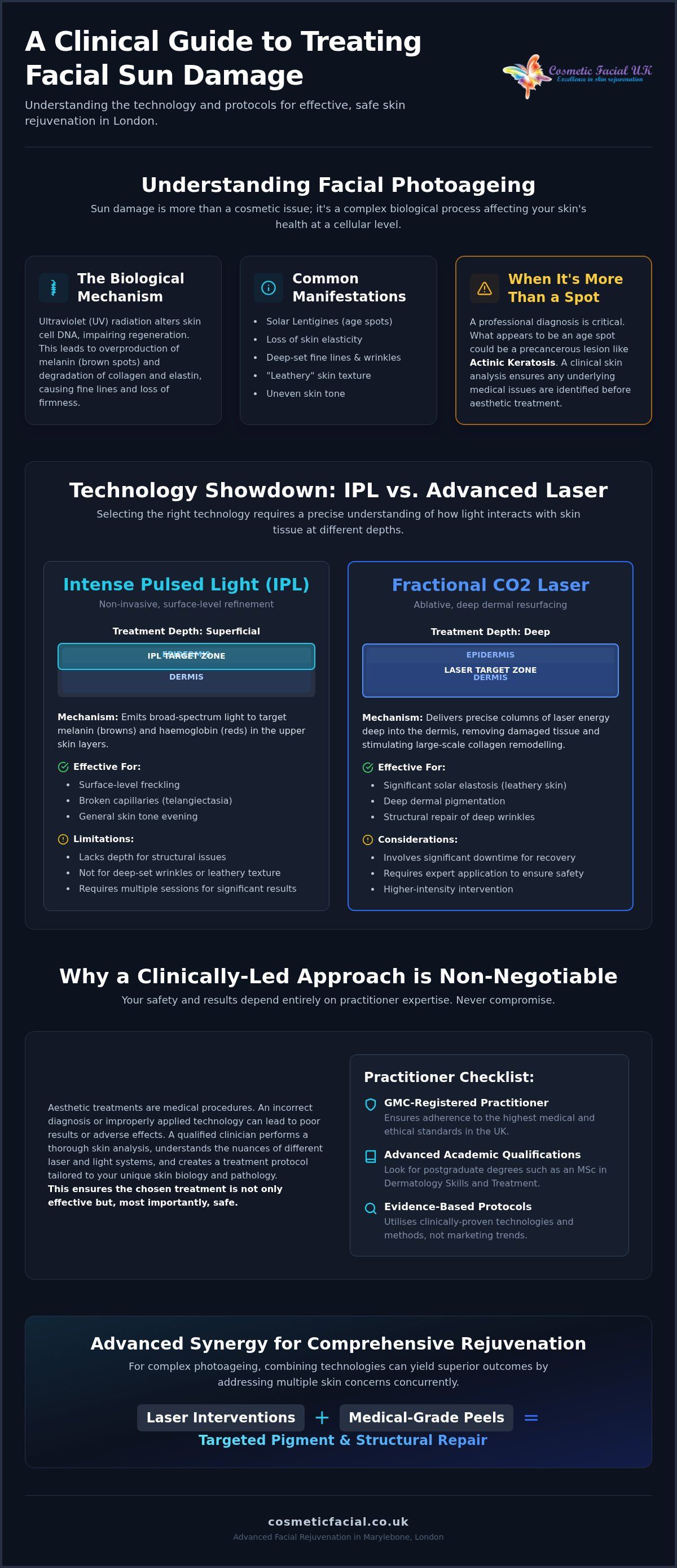
Sun damage is a complex biological process rather than a simple cosmetic concern. When ultraviolet (UV) radiation penetrates the dermis, it alters the fundamental DNA of skin cells, leading to abnormal cellular behaviour and impaired regenerative cycles. This chronic exposure manifests as photoageing, a state where the skin's chronological age is surpassed by its environmental wear. Residents seeking facial rejuvenation in the capital often present with accelerated symptoms. This is frequently due to the synergy between UV exposure and urban particulate matter. Research suggests that pollution can amplify the oxidative stress caused by the sun, leading to deeper textural changes and more stubborn pigmentation patterns.
Gaining a comprehensive Understanding Facial Photoageing involves recognising how light-based therapies address these cellular alterations. Symptoms typically range from a loss of elasticity to the appearance of "leathery" skin. Whilst many individuals seek laser treatment for sun damage on face london to improve their appearance, the medical necessity of addressing these changes is equally significant for maintaining long-term skin health.
The Biological Mechanism of UV Damage
The skin's primary defence against UV radiation is the production of melanin by cells called melanocytes. Chronic exposure causes these cells to become overactive or cluster, resulting in the irregular brown patches known as solar lentigines or age spots. Beyond pigment, UV rays trigger solar elastosis, which is the significant degradation of elastin and collagen fibres. This breakdown results in a loss of structural integrity and the formation of deep-set fine lines. Much of this damage exists deep amongst the lower skin layers for years before it eventually surfaces, making early clinical intervention a logical step for preserving the skin's foundation.
When is a Spot More Than Just Pigment?
Distinguishing between benign sun damage and pathological changes is a critical step before undergoing any laser treatment for sun damage on face london. Whilst solar lentigines are harmless, actinic keratosis represents a precancerous change that feels rough or scaly and requires medical intervention. It's vital to have a comprehensive mole check conducted by a GMC-registered practitioner to rule out malignancy. Self-diagnosis of sun damage is inherently risky; what appears as a simple "age spot" could be a lentigo maligna. Professional skin analysis ensures that aesthetic treatments are only applied to healthy tissue, maintaining the highest standards of clinical safety and ensuring that "hidden" issues are addressed appropriately.
IPL vs. Laser: Choosing the Right Technology
Selecting the appropriate technology requires a precise understanding of how light interacts with biological tissue. Whilst many high-street facilities offer basic Intense Pulsed Light (IPL) services, a clinical environment provides access to medical-grade systems designed for specific dermal depths. The primary distinction lies in whether the treatment is non-ablative, which leaves the skin surface intact, or ablative, which removes thin layers of damaged tissue. For patients seeking a laser treatment for sun damage on face london, the choice between these modalities determines both the recovery time and the final outcome. Precision is the priority. The Cynosure Apogee Elite represents a significant advancement in non-ablative technology; by utilising dual wavelengths, it allows for the precise targeting of pigment whilst protecting the surrounding epidermis.
IPL for Sun Damage on Face UK: Benefits and Limits
Intense Pulsed Light operates by emitting broad-spectrum light that targets "colours" within the skin, specifically the red of haemoglobin and the brown of melanin. It's particularly effective for treating surface-level freckling and telangiectasia, or broken capillaries, caused by cumulative UV exposure. Because it's non-invasive, it requires minimal downtime, making it a popular choice for those with busy city schedules. However, IPL has distinct limitations. It lacks the depth required to address structural issues like deep-set wrinkles or leathery texture. Most clinical protocols recommend a series of sessions to achieve meaningful clearance of pigment. It's a tool for surface refinement rather than deep structural repair.
Advanced Laser Resurfacing with Fractional CO2
When photoageing involves significant solar elastosis and deep dermal damage, a Fractional CO2 laser is the established clinical standard. This ablative technology works by creating microscopic thermal zones within the skin, leaving columns of untreated tissue to facilitate rapid healing. This process triggers a robust regenerative response, replacing damaged fibres with new, organised collagen. It's the most effective method for resurfacing the skin and repairing the structural integrity lost to decades of sun exposure. This treatment is often the preferred choice for complex cases where texture is as much a concern as pigment.
Before proceeding with such powerful technology, a clinically-led consultation is mandatory to assess your skin's suitability and manage expectations regarding recovery. Choosing the correct laser treatment for sun damage on face london ensures that the intervention matches the severity of the damage. You can find more information about our medical aesthetic services by speaking with a specialist to determine your specific requirements.
The Importance of a Clinically-Led Consultation
The efficacy of any laser treatment for sun damage on face london relies heavily on the initial diagnostic phase. A clinical consultation serves as more than a preliminary discussion; it's a rigorous medical assessment required to ensure patient safety and treatment precision. Opting for a GMC-registered practitioner ensures that the individual performing the procedure's bound by strict professional standards and possesses the medical knowledge to manage complex skin responses. During this stage, we develop a bespoke facial rejuvenation plan London patients can trust, tailored to their specific dermatological needs. A primary focus is the assessment of the Fitzpatrick scale, which categorises skin types based on their response to UV light. This step's vital to prevent complications such as post-inflammatory hyperpigmentation, which can occur if laser settings aren't precisely calibrated to the patient's biological profile.
Academic Credentials of Dr Faramarz Didar
Expertise in laser technology's built upon a foundation of formal academic study. Dr Didar holds an MSc in Dermatology Skills and Treatment from the University of Hertfordshire, awarded with Commendation. This advanced degree represents a level of specialist knowledge that exceeds standard aesthetic training found in many high-street clinics. His credentials also include a Postgraduate Diploma in Non-Surgical Facial Aesthetics. To maintain clinical excellence, he engages in ongoing professional development with the European College of Aesthetic Medicine & Surgery. This commitment to academic rigour ensures that every protocol's informed by the latest evidence-based practices in dermatology.
Comprehensive Skin Analysis in Marylebone
The diagnostic process at our Marylebone clinic involves a thorough examination of both the skin's surface and its underlying health. We review your full clinical history to identify potential contraindications, such as the use of photosensitising medications or active infections. Visual cues, such as the depth of solar lentigines and the presence of telangiectasia, help us organise a safe treatment path. This unhurried approach allows us to determine the most appropriate laser treatment for sun damage on face london for each individual. By prioritising medical analysis over high-volume throughput, we ensure that every intervention's both safe and effective for the long term.
Treatment Journey and Recovery in London
Successful outcomes for laser treatment for sun damage on face london begin long before the first pulse of light reaches the dermis. We require patients to adhere to a specific pre-treatment protocol designed to strengthen the skin barrier and suppress overactive melanocytes. This preparation often involves the use of medical-grade topical agents that stabilise the epidermis, significantly reducing the risk of adverse responses. Whilst in the chair, patients typically experience a sensation described as a series of brief, thermal snaps against the skin. We utilise integrated cooling technologies to maintain comfort throughout the procedure. Timing is a significant factor in the clinical journey. We consider autumn and winter to be the favourite seasons for laser intervention in the UK. The lower UV index during these months provides a safer environment for the skin to regenerate without the threat of intense solar exposure interfering with the healing process.
The Recovery Timeline
The healing process follows a predictable clinical sequence that requires patient compliance. Immediately following the procedure, the skin will exhibit erythema, or redness, and mild oedema, similar to the sensation of a moderate sunburn. Within three to five days, you may notice the "coffee ground" effect. This occurs when targeted pigment rises to the surface and naturally sloughs away. It's essential to manage the skin with pH-balanced, non-irritating cleansers whilst it heals. You can read a detailed account of the recovery from CO2 laser treatment day by day to better prepare for your specific downtime requirements.
London-Specific Aftercare Challenges
Recovering in an urban environment presents unique challenges that can impact the final result. High levels of particulate matter and nitrogen dioxide can irritate the skin whilst the protective barrier's temporarily compromised. We advise a strict regimen of broad-spectrum SPF 50, even on the frequently overcast days characteristic of the London climate. Protecting the treated area from environmental pollutants is as vital as the procedure itself. Patients must avoid intense exercise and environments with excessive heat, such as saunas or steam rooms, for at least 48 hours to prevent exacerbating inflammation. This unhurried approach to recovery ensures the longevity of your results.
Advanced Facial Rejuvenation at Cosmetic Facial
Effective sun damage reversal often requires more than a single technology. At Cosmetic Facial, we integrate multiple clinical modalities to address the multi-layered nature of solar damage. For patients seeking a comprehensive non-surgical face lift London, we often combine light-based therapies with structural interventions. This layered approach ensures that both pigmentation and dermal laxity are treated concurrently. Choosing a laser treatment for sun damage on face london at our clinic involves a strategic assessment of how different energies interact with your skin. We often utilise the synergy between lasers and medical-grade skin peels to refine surface texture whilst the laser addresses deeper dermal issues. Secondary concerns, including the softening of deep-set creases, are managed through targeted line and wrinkle treatment. Our objective is always to achieve natural-looking results that respect your unique facial anatomy through precise clinical technique.
Tailored Treatment Packages in Marylebone
Multi-layered damage requires multi-layered solutions. We frequently combine IPL and fractional laser sessions to clear superficial redness and deep-set pigment simultaneously. To maintain the results of your laser treatment for sun damage on face london, we prescribe specific medical-grade skincare regimens. These products support the skin's barrier and inhibit future melanocyte overproduction. Uniquely, our patients have access to comprehensive health checks through our specialist GP services. This medical-first approach ensures that your aesthetic plan is supported by your overall physiological health. We organise these treatments into a logical sequence that prioritises skin safety and long-term stability.
Why Choose Our Marylebone Clinic?
Selecting a clinic in the capital requires careful consideration of the practitioner's medical pedigree. Under the care of Dr Didar, patients receive expert treatment amongst a professional clinical setting designed for safety and precision. We intentionally avoid the high-volume "conveyor belt" environment common in larger aesthetic chains. Every patient receives personalised attention, with a focus on long-term skin health rather than quick, temporary fixes. This unhurried, academic approach to dermatology ensures that each treatment path is both thorough and medically sound. We prioritise intellectual honesty, acknowledging the limits of technology whilst striving for the highest possible clinical outcomes. Our location in Marylebone provides a discreet and professional environment for your entire treatment journey.
Restoring Skin Health with Clinical Precision
Reversing solar damage requires a methodical approach that prioritises medical safety alongside aesthetic outcomes. We've explored the biological mechanisms of photoageing and the necessity of a professional diagnosis to distinguish benign pigment from pathological changes. Selecting the correct laser treatment for sun damage on face london depends on whether your clinical needs require surface-level IPL refinement or the deep structural repair of Fractional CO2 technology. Each modality offers specific benefits that must be matched to your unique Fitzpatrick skin type and the depth of the solar elastosis present.
At our Marylebone clinic, Dr Faramarz Didar (GMC 5200505) provides expert guidance informed by his MSc in Dermatology Skills and Treatment, awarded with Commendation. This academic foundation ensures that your treatment journey's both safe and evidence-based. By following a structured recovery protocol and protecting your skin from the unique challenges of the London environment, you can achieve a clearer, more resilient complexion. We're committed to delivering results that enhance your natural appearance whilst maintaining the highest standards of clinical integrity.
Book a Clinical Consultation with Dr Didar in Marylebone
Taking the first step toward skin health provides the clarity needed to make an informed decision about your rejuvenation path.
Frequently Asked Questions
Is laser treatment for sun damage on the face painful?
Laser treatment for sun damage on the face is generally well-tolerated and is often described as a series of brief, thermal snaps against the skin. For non-ablative procedures, we utilise integrated cooling systems to maintain comfort throughout the session. When performing deeper resurfacing with a Fractional CO2 laser, we apply a topical anaesthetic to ensure the procedure is manageable. Most patients find the sensation of heat dissipates quickly after the clinical session concludes.
How many IPL sessions will I need for my sun spots?
Most clinical protocols for pigment clearance require between three and five IPL sessions to achieve optimal results. These appointments are typically spaced four weeks apart to allow the skin's natural regenerative cycle to process the targeted melanin. The exact number of sessions depends on the contrast between the solar lentigines and the surrounding tissue. A professional skin analysis in Marylebone provides a more accurate estimate based on your specific dermatological profile and history.
What is the cost of laser skin resurfacing in London?
The financial investment for a laser treatment for sun damage on face london varies significantly depending on the technology selected and the surface area involved. Non-ablative IPL sessions differ in cost from intensive Fractional CO2 resurfacing due to the complexity and clinical oversight required. We provide a transparent, itemised fee structure during your initial medical assessment. This ensures the treatment plan aligns with your clinical requirements and desired outcomes without any hidden costs.
Can laser treatments be used on darker skin tones safely?
Laser treatments can be performed safely on darker skin tones provided the practitioner utilises specific wavelengths and conservative energy settings. Patients with higher Fitzpatrick skin types require systems like the Cynosure Apogee Elite, which can precisely target pigment without over-heating the surrounding epidermis. This methodical approach is essential to prevent post-inflammatory hyperpigmentation. A thorough clinical history is always taken to assess individual risk factors before any light-based intervention commences at our clinic.
How long do the results of a sun damage laser treatment last?
The clearance of specific solar lentigines is permanent, but the skin remains susceptible to new UV damage over time. Results typically remain stable for several years if the patient adheres to a strict broad-spectrum SPF regimen and avoids peak solar radiation. Many patients choose an annual maintenance session to address any emerging environmental wear. Long-term skin health is also supported by the medical-grade skincare products we prescribe following your clinical procedure to maintain the dermal barrier.
What is the difference between IPL and a Fractional CO2 laser?
The primary difference lies in the target of the energy: IPL addresses colour, whereas Fractional CO2 addresses skin structure. IPL is a non-ablative light therapy that targets surface-level redness and brown pigment without damaging the epidermis. In contrast, a Fractional CO2 laser is an ablative technology that removes microscopic columns of tissue to trigger deep collagen remodelling. This makes CO2 more effective for treating leathery texture and deep-set wrinkles caused by cumulative photoageing.
Can I go back to work immediately after a laser facial?
Your ability to return to work depends entirely on the specific modality used during your session. Patients undergoing non-ablative IPL or dual-wavelength pigment targeting can usually resume professional duties immediately, as any mild erythema is easily concealed. However, intensive resurfacing with a Fractional CO2 laser involves a recovery period of five to seven days. During this time, the skin will exhibit visible healing and crusting that is not suitable for most professional or social environments.
Are there any side effects I should be worried about?
Expected side effects include temporary erythema, mild oedema, and a sensation of warmth similar to a moderate sunburn. Within a few days of a laser treatment for sun damage on face london, you may observe "micro-crusting" as targeted pigment rises to the surface. These are normal biological responses that indicate the treatment is effective. Serious complications, such as scarring or persistent dyschromia, are exceedingly rare when the procedure is overseen by a GMC-registered dermatology specialist.
Disclaimer
All content on cosmetic Facial website, including blogs, graphics, logos, images, and software, is the property of CosmeticFacial UK or its content suppliers and is protected by applicable copyright laws. Unauthorized use, reproduction, distribution, or modification of any content without prior written permission is strictly prohibited.


