


No topical moisturiser, regardless of price or formulation, can repair structurally depleted cervical skin. True dermal restoration demands clinical intervention beneath the surface. Patients seeking clinical treatment for crepey skin on neck London practices offer often arrive after spending considerable sums on rich firming balms, only to find the delicate, crinkling texture remains largely unaltered.
It is entirely natural to feel frustrated by persistent horizontal rings and laxity along the jawline, particularly when confronting conflicting claims about competing energy devices and downtime. We promise to explain the medical biology driving this dermal thinning and outline the clinically proven non-surgical interventions capable of rebuilding the structural matrix.
Below, you will examine the comparative evidence between high-intensity focused ultrasound, radiofrequency, fractional ablative laser, and injectable biostimulators, equipping you to evaluate specialist London clinics with clarity and confidence.
Key Takeaways
- Explore the biological causes of cervical skin thinning, including low sebaceous gland density and progressive extracellular matrix degradation.
- Compare the therapeutic actions of ultrasound, radiofrequency, fractional ablative laser, and injectable biostimulators across specific dermal planes.
- Discover why an evidence-based clinical treatment for crepey skin on neck London specialists provide avoids the downtime and risks of invasive surgery.
- Learn how medical practitioners evaluate skin thickness, photodamage, and underlying tissue dynamics to formulate individualised rejuvenation plans.
- Understand the clinical advantages of physician-led assessment and combined therapeutic modalities at our Marylebone practice.
Understanding Crepey Neck Skin: Pathophysiology and Clinical Causes
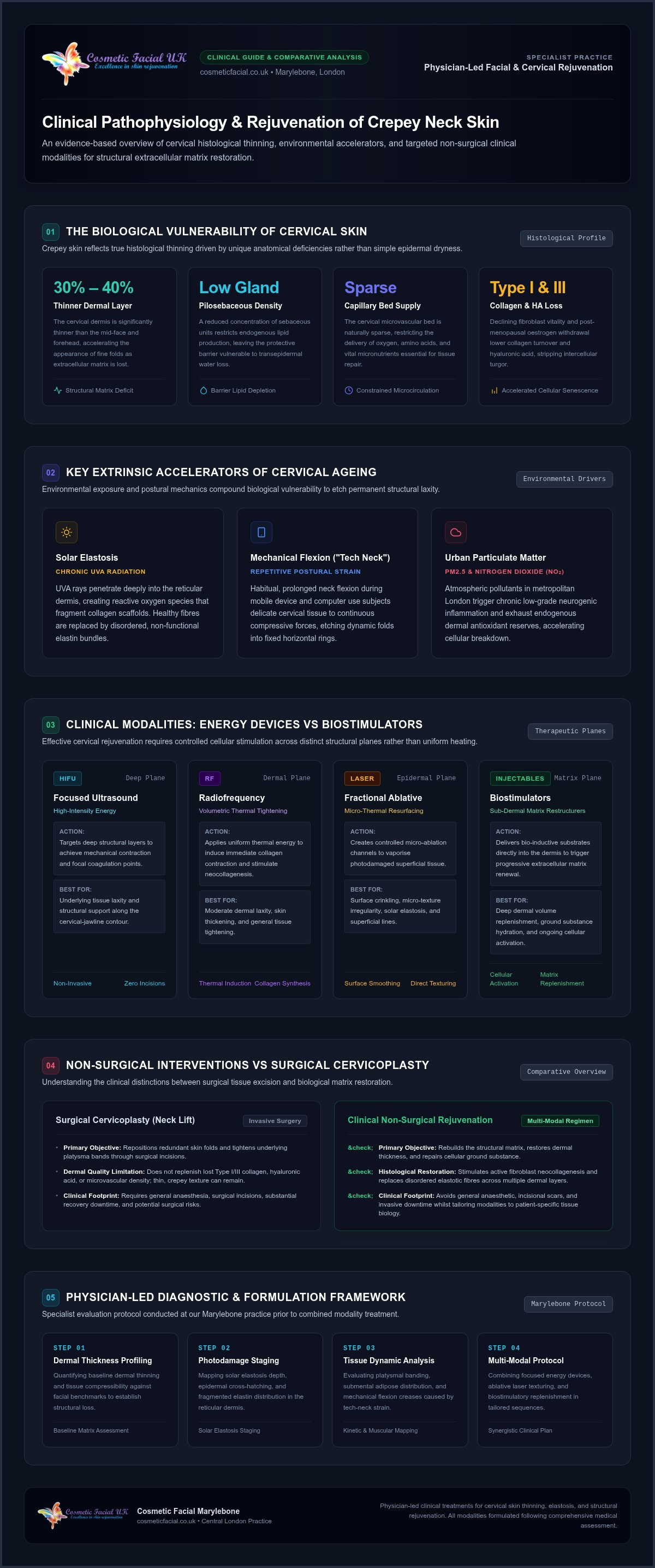
Crepey neck skin represents true histological thinning rather than mere superficial dryness. Unlike the facial dermis, cervical tissue possesses a markedly reduced concentration of pilosebaceous units. This absence limits endogenous lipid production, leaving the protective epidermal barrier inherently vulnerable to transepidermal water loss. The cervical microvascular capillary bed is similarly sparse, restricting the baseline delivery of oxygen, amino acids, and micronutrients required for ongoing tissue repair. Consequently, when patients seek effective treatment for crepey skin on neck london medical practitioners must address these underlying anatomical deficiencies rather than offering simple surface emollients.
To examine the systemic and hormonal contributors that accelerate dermal breakdown in this region, watch this clinical overview by a Central London aesthetic doctor:
The Biological Mechanisms of Cervical Dermal Thinning
The progression of cervical skin laxity stems from an accelerated imbalance between matrix metalloproteinase activity and dermal matrix synthesis. As fibroblast proliferation declines, the turnover of structural Type I and Type III collagen drops significantly. Cervical dermis is approximately 30 to 40 percent thinner than the mid-face and forehead, meaning extracellular matrix loss manifests rapidly as fine, crinkling folds. At the same time, endogenously synthesised hyaluronic acid diminishes, stripping the intercellular ground substance of turgor. Post-menopausal oestrogen withdrawal exacerbates this cellular senescence, directly impeding fibroblast vitality and accelerating clinical elastosis.
Extrinsic Accelerators: Photoageing and Modern Postural Strain
Extrinsic environmental factors interact with these structural vulnerabilities to speed clinical decline. The primary driver of premature cervical ageing is cumulative ultraviolet radiation without adequate photoprotection, leading to the recognised causes of skin wrinkles where disordered, non-functional elastin bundles replace organized structural matrices.
- Solar Elastosis: Chronic UVA exposure penetrates deeply into the reticular dermis, generating reactive oxygen species that fragment collagen scaffolds.
- Mechanical Flexion ("Tech Neck"): Habitual, prolonged neck flexion during mobile screen use subjects fragile tissue to continuous compressive forces, etching dynamic wrinkles into permanent horizontal rings.
- Urban Particulate Matter: London's atmospheric pollutants, including microparticulates (PM2.5) and nitrogen dioxide, trigger chronic low-grade neurogenic inflammation and deplete dermal antioxidant reserves.
Understanding these distinct physical and extrinsic drivers ensures that any prescribed treatment for crepey skin on neck london clinics formulate combines dermal matrix thickening with deep cellular regeneration.
Clinical Modalities for Crepey Neck Skin: Energy Devices vs Biostimulation
Clinical correction of thin cervical tissue requires controlled cellular stimulation rather than uniform heating. Every patient presents with distinct structural needs based on dermal thickness, local adipose volume, and elastotic progression. To choose the most effective treatment for crepey skin on neck london practitioners evaluate whether a patient requires physical mechanical contraction, deep dermal volume replenishment, or surface texturing. Medical research into how aging affects your skin confirms that multiple structural layers deteriorate simultaneously, which means relying on a single device rarely yields comprehensive rejuvenation.
High-Intensity Focused Ultrasound (HIFU) and Radiofrequency Tightening
Focused energy devices target distinct tissue depths to contract compromised collagen fibres. High-intensity focused ultrasound delivers micro-focused thermal coagulation points directly into the deep reticular dermis and the superficial muscular aponeurotic system (SMAS) at depths of 1.5mm to 4.5mm. In contrast, radiofrequency generates volumetric bulk heating within the mid-to-deep dermis, triggering immediate triple-helix collagen contraction followed by protracted neocollagenesis. These distinct mechanics explain why ultrasound suits patients with mild submental laxity, whereas radiofrequency excels for general surface crinkling; patients can explore this deeper tightening approach within our non-surgical face lift protocols.
Biostimulatory Injectables, Mesotherapy, and Autologous PRP
Biostimulation acts directly on cellular machinery rather than applying thermal shock. Instead of shrinking existing proteins, these treatments stimulate host fibroblasts to rebuild the extracellular matrix:
- Poly-L-Lactic Acid (Sculptra): Micro-particles induce a subclinical, controlled foreign-body macrophage response, triggering robust de novo Type I collagen synthesis over three to six months.
- Targeted Mesotherapy: Micro-droplet dermal injections introduce uncrosslinked hyaluronic acid, amino acids, and essential coenzymes directly into the papillary dermis to restore intercellular hydration.
- Autologous Platelet-Rich Plasma (PRP): Concentrated platelets release vascular endothelial growth factor (VEGF) and transforming growth factor-beta, accelerating local microvascular repair and cellular renewal.
Fractional Resurfacing and Chemical Exfoliation for Epidermal Texture
Surface crinkling often demands textural refinement alongside deeper structural support. Fractional CO2 laser creates microscopic thermal ablation columns surrounded by uninjured tissue islands, accelerating re-epithelialisation whilst vaporising damaged superficial elastotic fibres. For delicate neck tissue that cannot tolerate intense thermal spread, mild chemical peels offer controlled exfoliation to even out cellular turnover. Pairing these clinical resurfacing options with bio-remodelling provides a comprehensive restorative protocol, which you can discuss in detail by arranging a clinical assessment at our Marylebone clinic.
Non-Surgical Interventions vs Surgical Cervicoplasty: Expectations and Suitability
Determining the boundary between non-surgical tightening and open surgical excision requires rigorous diagnostic assessment. While non-invasive clinical interventions excel at reversing structural dermal thinning, they cannot repair pronounced separation of the underlying musculature. Patients seeking an effective treatment for crepey skin on neck london practitioners offer must establish whether their visible concerns stem from cutaneous laxity or deeper muscular detachment.
Evaluating Clinical Boundaries: Dermal Atrophy Versus Muscular Diastasis
A clinical pinch assessment measures cutaneous elasticity and recoil velocity. When pinched between thumb and forefinger, skin that displays fine crinkling but snaps back within one to two seconds demonstrates good non-surgical contraction potential. In these cases, energy devices and biostimulatory agents yield notable improvements in dermal thickness. Conversely, vertical muscular bands that appear prominently when pronouncing the letter "e" reflect platysma diastasis; this represents a muscular pathology rather than pure cutaneous ageing. While neuromodulators can soften hyperdynamic bands, significant muscular separation and severe skin redundancy lie beyond non-surgical capabilities.
| Clinical Parameter | Non-Surgical Modalities | Surgical Cervicoplasty |
|---|---|---|
| Primary Indication | Dermal thinning, surface crepiness, mild laxity | Severe tissue redundancy, platysma diastasis |
| Anaesthesia | Topical numbing or none | General anaesthesia or IV sedation |
| Downtime | Zero to 5 days transient swelling | 14 to 28 days wound healing |
| Tissue Mechanics | Endogenous collagen and elastin remodelling | Mechanical plication and surgical skin excision |
Downtime, Recovery Profiles, and Procedure Longevity
Non-invasive procedures bypass the surgical risks of haematoma formation, permanent scarring, and prolonged nerve dysaesthesia. Following clinical protocols such as fractional radiofrequency, micro-needling, or ultrasound, patients experience mild erythema and localized oedema that typically settles within 24 to 72 hours. Injectable biostimulators may produce slight pinpoint bruising at injection sites, which resolves rapidly without interrupting daily working commitments.
Cellular synthesis requires patience. Initial tissue firming emerges as thermal energy contracts existing fibres, but comprehensive clinical results appear between 8 and 16 weeks as nascent fibroblasts mature. Because natural degradation continues, maintaining results requires planned annual touch-up sessions. This structured protocol preserves structural density over the long term without altering the natural anatomy of the cervical region.
How London Aesthetic Specialists Formulate a Neck Rejuvenation Plan
Successful non-surgical correction relies on a phased medical pathway rather than single-session appointments. Cervical dermis requires structured biological priming before undergoing intense thermal contraction or fractional ablation. When prescribing a comprehensive treatment for crepey skin on neck london specialists establish a four-stage clinical pathway to ensure tissue responses remain safe, controlled, and predictable.
- Diagnostic Palpation and Imaging: Objective evaluation of epidermal thinning, subcutaneous lipid atrophy, and photographic cross-polarised analysis to map vascular integrity.
- Systemic and Extrinsic Screening: Review of metabolic contributors, including thyroid dysfunction, hormonal shifts, and past response to dermal interventions.
- Stratified Multimodal Scheduling: Sequential application of deep acoustic or radiofrequency energy followed by biostimulatory matrix replenishment.
- Barrier Fortification: Prescription of lipid-replenishing topical regimens containing ceramides, peptides, and physical broad-spectrum mineral filters.
Comprehensive Dermal Assessment in Central London
Precision begins with rigorous physical diagnostic tests. Specialists evaluate the degree of dermal recoil across the submental and lower cervical regions, grading solar elastosis against standard clinical photographic scales. Investigating systemic background factors is equally essential; subclinical endocrine fluctuations or autoimmune tendencies directly alter fibroblast reactivity. Patients benefit from coordinating an initial medical review, identical to the clinical pathways outlined in our guide to private dermatologist consultations in London.
Designing Layered Treatment Synergies for Optimal Neocollagenesis
Timing between distinct treatment modalities determines clinical success. Delivering thermal energy immediately after injecting biostimulators can disrupt synthetic microspheres or degrade uncrosslinked hyaluronic acid prematurely. Medical practitioners therefore introduce deep tissue contraction first:
- Phase One (Foundation): High-intensity ultrasound or radiofrequency induces deep reticular neocollagenesis and immediate structural tightening.
- Phase Two (Matrix Repletion): Three to four weeks post-energy treatment, intradermal biostimulators, such as poly-L-lactic acid or autologous PRP, repopulate the depleted ground substance.
- Phase Three (Refinement): Controlled micro-needling or gentle chemical peels refine superficial texture once deeper structural matrices have stabilised.
This staged approach mirrors the structural methodology outlined in our full face rejuvenation plan guide, ensuring cellular stimulation proceeds without inducing chronic inflammation.
Physician-Led Neck Rejuvenation at Cosmetic Facial Marylebone
Selecting a clinical environment for cervical rejuvenation demands rigorous attention to practitioner credentials and medical safety standards. While commercial aesthetic chains often assign energy-based treatments to non-medical personnel, Cosmetic Facial operates exclusively as a doctor-led practice in Central London. Every clinical consultation, anatomical diagnosis, and procedural intervention is conducted personally by Dr Faramarz Didar, MD. This medical governance model ensures patients seeking a dedicated treatment for crepey skin on neck london practitioners deliver receive care rooted in clinical dermatology rather than sales-driven protocol packages.
Medical Qualifications and Clinical Dermatology Expertise
Dermal thickness varies significantly across the neck, making advanced training essential to avoid vascular or nerve complications. Dr Didar holds an MSc in Dermatology Skills with Commendation from the University of Hertfordshire, alongside postgraduate medical qualifications certified by the UK PMETB. Maintaining continuous General Medical Council registration (GMC reference 5200505), he has completed advanced international training in clinical aesthetic dermatology with the European Academy of Dermatology and Venereology (EADV) and the Instituto Javier de Benito in Barcelona. These clinical foundations ensure treatments follow peer-reviewed safety thresholds across every energy modality and biostimulatory injectable.
Our private Marylebone clinical rooms house a versatile spectrum of medical technologies configured specifically for fine cervical tissue:
- High-Intensity Focused Ultrasound (HIFU): Precision transducers calibrated for subtle subdermal contraction without risking deep facial nerve trauma.
- Medical Radiofrequency: Monopolar and bipolar bulk thermal systems designed to induce predictable collagen fibril remodelling.
- Fractional CO2 Laser Resurfacing: Microscopic column ablation configured for minimal thermal diffusion on thin neck skin.
- Collagen Biostimulators and Mesotherapy: Clinically proven agents, including Sculptra, autologous PRP, and uncrosslinked micro-droplet nutrition.
Scheduling Your Clinical Neck Assessment in London
Conveniently located in Marylebone, our practice serves individuals across Central London, Westminster, and the surrounding boroughs. Consultations are deliberate and unhurried; we prioritise clear diagnostics over hasty procedural bookings. Dr Didar assesses your tissue elasticity, discusses realistic structural outcomes, and details the recovery parameters for each recommended modality. Patients receive objective, measured guidance within a calm, professional medical setting. To begin your clinical restoration, consult Cosmetic Facial for specialised neck rejuvenation and arrange an in-depth dermatological examination.
Restoring Cervical Dermal Integrity Through Clinical Precision
Reversing delicate neck crepiness requires an accurate histological strategy rather than superficial cosmetic cover. As demonstrated, meaningful clinical restoration relies on pairing deep thermal neocollagenesis through focused ultrasound or radiofrequency with targeted extracellular matrix replenishment. When selecting a clinical treatment for crepey skin on neck london patients achieve the most enduring, natural outcomes under rigorous medical governance.
At Cosmetic Facial in Marylebone, all patient pathways are overseen by Dr Faramarz Didar, MD. Holding an MSc in Dermatology Skills with Commendation from the University of Hertfordshire and full General Medical Council registration (GMC 5200505), Dr Didar delivers measured, individualised clinical care designed to strengthen dermal architecture safely.
Taking a considered, doctor-led approach ensures your skin receives the precise biological support needed to regain resilience, smoothness, and lasting structural vitality.
Frequently Asked Questions
Can non-surgical treatments completely reverse crepey skin on the neck?
Non-surgical modalities substantially thicken dermal tissue and reduce crepiness, but they cannot completely reverse advanced architectural damage. Clinical interventions such as high-intensity focused ultrasound, radiofrequency, and injectable biostimulators trigger measurable neocollagenesis. This process smooths crinkling and restores elasticity. However, patients with severe skin redundancy or pronounced platysmal muscle separation require realistic expectations regarding the physiological limits of non-excisional regeneration.
How many clinical sessions are typically required to improve neck skin firmness?
Most patients require an initial course of two to four clinical sessions spaced three to six weeks apart. Single-session focused ultrasound delivers gradual tightening over several months, whereas radiofrequency, micro-needling, and mesotherapy achieve optimal cumulative results through a structured series. During your consultation, we design a phased schedule tailored to your measured baseline dermal thickness and cellular recovery rates.
Is treatment for crepey neck skin painful, and what anaesthetic is used?
Procedural discomfort remains minimal and highly manageable across all modalities. We apply a prescription-strength topical anaesthetic cream containing lidocaine to the cervical region thirty to forty-five minutes before energy-based or injectable procedures. Patients undergoing energy treatments experience a warm, prickling sensation or localized deep aching, while injectable biostimulation involves only fleeting pinpoint pinches.
What is the recovery downtime following energy-based neck skin tightening?
Downtime remains minimal, typically lasting between 24 and 72 hours. Patients frequently experience mild erythema and slight subcutaneous swelling directly after radiofrequency or focused ultrasound, which resolves quickly without peeling. Fractional laser resurfacing requires three to five days of localized redness and delicate micro-crusting. You can comfortably resume standard professional and social routines immediately following most non-ablative protocols.
How does neck skin tightening differ from treating facial skin laxity?
Cervical tissue possesses fewer sebaceous glands, a thinner dermis, and a sparser microvascular network than facial skin. These biological variations mean the neck heals more slowly and displays higher sensitivity to thermal injury. Consequently, delivering an effective treatment for crepey skin on neck London clinicians undertake requires lower energy fluences, tailored transducer depths, and specialised biostimulatory dilutions to prevent prolonged erythema.
Can skincare creams achieve the same results as clinical neck treatments?
Topical cosmetic creams cannot duplicate the structural remodelling achieved by medical interventions. Over-the-counter moisturizers temporarily hydrate the superficial stratum corneum, which temporarily softens the look of fine lines. However, topical molecules cannot penetrate deeply enough into the reticular dermis to contract stretched elastin fibres, induce bulk thermal tightening, or stimulate sustained fibroblast neocollagenesis.
Are treatments for crepey neck skin safe for all skin phototypes?
Yes, tailored non-surgical treatments are safe across all Fitzpatrick skin phototypes when administered by experienced medical practitioners. When selecting a clinical treatment for crepey skin on neck London patients with darker complexions (phototypes IV to VI) benefit most from modalities that bypass epidermal melanin. Radiofrequency, focused ultrasound, and collagen biostimulators carry negligible risk of post-inflammatory hyperpigmentation compared to aggressive ablative lasers.
Disclaimer
All content on cosmetic Facial website, including blogs, graphics, logos, images, and software, is the property of CosmeticFacial UK or its content suppliers and is protected by applicable copyright laws. Unauthorized use, reproduction, distribution, or modification of any content without prior written permission is strictly prohibited.


