


When moisturising alone has not helped, or acne scarring leaves pitted areas and makeup settles unevenly, it is understandable to look for a more targeted approach. Learning how to improve skin texture on face starts with identifying the cause: enlarged-looking pores, surface roughness and scarring may need different strategies.
This guide explains how skin renewal and targeted resurfacing may support a smoother-looking complexion, rather than relying on surface exfoliation alone. You will learn what can contribute to uneven texture, why professional skin analysis matters, and how options such as microneedling, skin peels and Fractional CO2 laser may be considered. Each approach has different uses and recovery considerations, so treatment suitability depends on your individual concerns and skin.
Key Takeaways
- Keratinocyte build-up, photo-damage and changes in dermal support can all contribute to uneven skin texture.
- Resurfacing treatments, including skin peels and laser treatments, may support skin renewal when selected appropriately.
- Regenerative approaches such as Mesotherapy aim to support skin quality from within.
- A tailored plan informed by professional skin analysis is more appropriate than a one-size-fits-all approach.
- Treatment choice, practitioner expertise and the equipment used are important considerations when comparing options for a smoother-looking complexion.
Understanding the Pathophysiology of Uneven Skin Texture
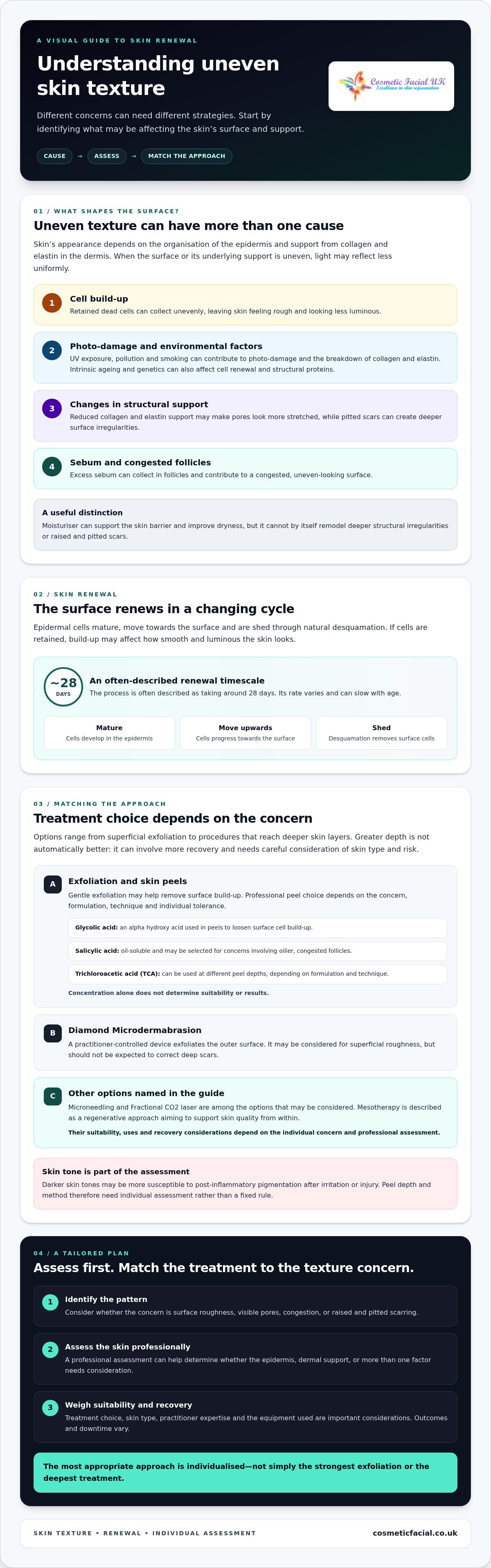
Skin texture describes the feel and appearance of the surface, from smooth and even to rough, flaky or indented. It depends on the organisation and thickness of the epidermis, the outer layer, as well as support from structures such as collagen and elastin in the dermis beneath it. When these layers become uneven or lose support, light reflects less uniformly. The complexion may look dull, and pores or acne scars can appear more noticeable.
Texture changes can have several causes. Intrinsic ageing, influenced partly by genetics, gradually affects cell renewal and the skin’s structural proteins. Extrinsic factors such as ultraviolet (UV) exposure, pollution and smoking can add photo-damage and contribute to the breakdown of collagen and elastin. Keratinocyte accumulation, excess sebum and pitted scarring may also affect the surface. This is why it helps to identify the pattern behind unevenness before treating every rough area as a hydration problem.
Daily behaviour can also affect the skin’s surface. This video discusses skin picking and practical ways to address it:
The Role of Cellular Turnover and Desquamation
As epidermal cells mature, they move towards the surface and are shed in a process often described as taking around 28 days. The rate varies and can slow with age. Desquamation is the natural shedding of epidermal cells from the skin’s surface. If dead cells are retained, they can collect unevenly, leaving skin feeling rough and looking less luminous as the surface scatters light. Gentle exfoliation may help remove surface build-up. Exfoliation methods include mechanical and chemical approaches, but suitability depends on skin condition and tolerance.
Pore Size and Structural Integrity
Pore visibility reflects several factors, including follicular structure, sebum and the support around the pore. Reduced collagen and elastin support may make pores look more stretched, while excess sebum can collect in follicles and contribute to a congested, uneven-looking surface. A moisturiser can support the skin barrier and improve dryness, but it cannot by itself remodel deeper structural irregularities or raised and pitted scars. Persistent texture concerns may therefore need an assessment of both the epidermis and the dermis before treatment options are considered.
Clinical Strategies for Targeted Epidermal Resurfacing
Resurfacing treatments range from superficial exfoliation to procedures that reach deeper skin layers. The right level depends on the concern: surface dullness may call for a different approach from acne scarring or pronounced irregularity. Clinical assessment can help determine whether to target the epidermis, support dermal remodelling, or consider more than one method. Greater treatment depth is not automatically better. It can involve more recovery and needs careful consideration of skin type and risk.
These procedures work through controlled removal or injury. The treatment creates a defined stimulus, followed by the skin’s repair response, which may support a smoother surface or collagen remodelling. Outcomes and downtime vary. This is one reason there is no single answer to how to improve skin texture on face: choosing the strongest exfoliant is not a substitute for matching treatment to the concern.
Chemical Peels and Professional Exfoliation
Glycolic acid is an alpha hydroxy acid used in peels to loosen surface cell build-up. Salicylic acid is oil-soluble and may be selected for concerns involving oilier, congested follicles. Trichloroacetic acid (TCA) can be used at different peel depths, depending on the formulation and technique. Over-the-counter products can support routine exfoliation, while a practitioner can select and apply a professional formulation according to the concern and the individual’s tolerance. Concentration alone does not determine suitability or results.
Diamond Microdermabrasion uses a device to exfoliate the outer surface. Its application is controlled by the practitioner and equipment, unlike a home scrub. It may be considered for superficial roughness, but it should not be expected to correct deep scars. Cosmetic Facial provides skin peels and resurfacing treatments. Peel choice also needs to account for Fitzpatrick skin type. Darker skin tones may be more susceptible to post-inflammatory pigmentation after irritation or injury, so depth and method require individual assessment rather than a fixed rule.
Fractional Technology and Mechanical Resurfacing
For more pronounced textural concerns, Fractional CO2 laser delivers microscopic columns of thermal energy while leaving surrounding tissue untreated. This fractional pattern prompts a wound-healing response and may stimulate collagen remodelling. Laser resurfacing is more intensive than superficial exfoliation, so suitability, settings and aftercare need professional consideration. Micro-Needling (Dermaroller) uses fine needles to create controlled channels in the skin. The resulting repair response may help remodel scar tissue and refine texture. Reviews of emerging skin resurfacing therapies discuss microneedling among clinical approaches and underscore the importance of technique and patient selection.
A professional skin analysis can help clarify which level of resurfacing may be appropriate. For information about the clinic and its available treatments, see Cosmetic Facial’s clinical skin treatments.
Regenerative Medicine: Improving Texture from Within
Resurfacing aims to remove or disrupt selected parts of the skin’s surface, whereas regenerative approaches focus on stimulating repair and supporting skin quality. The dermal matrix, a network of collagen, elastin and other structural components, supports the epidermis above it. Changes in this matrix can affect firmness and surface smoothness. A treatment plan may therefore consider both layers rather than concentrating only on exfoliation.
Bio-remodelling describes processes intended to encourage changes in the skin’s structure and quality over time. It is not an instant correction, and results depend on the individual, the treatment and the concern being addressed. Regenerative treatments may be relevant where dryness, fine lines or a crepey appearance sit alongside surface unevenness. A professional assessment helps establish whether this type of approach is appropriate or whether another option may be more suitable.
PRP (Dracula Face) and Growth Factor Therapy
PRP (Dracula Face) uses a sample of the patient’s blood, which is processed to concentrate platelets in plasma. Platelets contain signalling factors involved in the body’s repair processes, and the prepared plasma can be used as a regenerative treatment. It may be considered for fine lines and crepey-looking skin, although response varies and it should not be presented as a guaranteed way to rebuild collagen. Practitioners may combine PRP with Micro-Needling (Dermaroller), which creates controlled channels in the skin. Whether a combined approach is suitable depends on clinical assessment.
Mesotherapy and Dermal Hydration
Mesotherapy (Skin Nutrition) involves delivering selected ingredients into the skin. Depending on the formulation, these may include vitamins, minerals and hyaluronic acid, a water-binding substance. The aim is to support skin hydration and quality rather than add facial volume. Better hydration may soften the look of rough, dehydrated patches, but it will not necessarily correct deep scars or structural changes. Cosmetic Facial provides facial rejuvenation treatments, including Mesotherapy.
Maintenance needs are individual. A practitioner can discuss whether a course or repeat treatments may be appropriate, alongside skincare and other clinical options, without assuming that everyone needs ongoing sessions. This helps set realistic expectations and distinguish temporary improvements in hydration from longer-term changes in texture. To learn more about the clinic’s treatment options, visit Cosmetic Facial’s clinical treatment information.
How to Improve Skin Texture on Face: Developing a Tailored Plan
There is no single treatment plan for uneven skin. Roughness from surface build-up, enlarged-looking pores, acne scarring and laxity can have different causes, so assessment should come before choosing a procedure. A professional consultation considers skin type, medical history, current skincare, the areas affected and the outcome you hope to achieve. That turns the question of how to improve skin texture on face into an individual clinical plan, rather than a generic routine.
Step 1: Clinical Skin Analysis
A skin analysis identifies visible concerns and helps a practitioner decide whether further assessment is needed before treatment. Digital imaging, where available, may help show aspects of sub-surface pigmentation or sun damage that are not readily apparent in ordinary lighting. It should inform, not replace, clinical judgement. In a consultation, expect to discuss your concerns, relevant health and skincare history, suitable options, possible risks and aftercare. Dr Faramarz Didar holds an MSc in Dermatology Skills and Treatment with Commendation, a qualification relevant to assessing skin concerns and discussing treatment options. No qualification can guarantee a particular result.
Step 2: Selecting the Correct Modality
The choice depends on what is contributing to texture. HIFU is generally considered for deeper tissue support and tightening, while resurfacing treatments such as Fractional CO2 laser target surface irregularity and may be considered for selected scars. Read about HIFU treatment as one clinical option. Combining modalities may be considered when concerns affect different skin layers, but the sequence and suitability need individual assessment. This includes considering how the skin responds and whether recovery periods overlap.
Home care supports, rather than replaces, in-clinic treatment. Daily broad-spectrum SPF helps limit further UV damage, while a retinoid may be considered to support cell renewal. Introduce active ingredients cautiously and seek clinical advice if your skin is sensitive, you are pregnant or breastfeeding, or you are preparing for a procedure. A simple, consistent routine is often more appropriate than adding multiple exfoliants.
Timelines vary with treatment intensity and the concern being addressed. Hydration or superficial exfoliation may produce a temporary surface change, while collagen remodelling after more intensive resurfacing develops gradually and may involve visible recovery. Before treatment begins, the practitioner should explain expected downtime and when improvement may become apparent. Aggressive resurfacing can involve greater recovery, so discuss expectations and practical arrangements in advance.
The Cosmetic Facial Approach to Skin Refinement in Marylebone
Cosmetic Facial is based in Marylebone, London, and offers skin analysis and consultation services for people exploring concerns such as uneven texture, visible pores and acne scarring. A considered plan begins by understanding the skin and the outcome sought, then matching suitable options to the individual. This matters because surface roughness and deeper textural changes may call for different approaches.
The clinic’s treatment range includes Fractional CO2 laser, HIFU, Diamond Microdermabrasion, skin peels, Micro-Needling (Dermaroller), Mesotherapy (Skin Nutrition) and PRP (Dracula Face). These treatments have different purposes and levels of intensity. A broad range of options supports individual consideration; it does not mean every treatment is suitable for every patient. When comparing providers in London, ask how the practitioner will assess your skin, explain the proposed treatment and discuss recovery and aftercare.
Clinical Expertise in Central London
Dr Faramarz Didar holds an MSc in Dermatology Skills and Treatment with Commendation. This dermatology training is relevant to assessing skin concerns and discussing possible treatment options. When considering any cosmetic treatment, check the practitioner’s qualifications and relevant professional registration. No credential can guarantee a particular outcome. The aim of a personalised plan is to pursue a refined, natural-looking result that remains appropriate to the person’s features and skin condition, rather than a uniform or overstated change.
A consultation can clarify which concerns may be addressed, what a proposed treatment involves and what recovery may entail. If you are considering a broader approach, you can also discuss the clinic’s facial rejuvenation treatments.
Patient-Centred Outcomes and Aftercare
Aftercare should reflect the procedure performed and the patient’s skin response. Before treatment, ask what care is recommended during recovery, which skincare products or activities to avoid, and when to seek advice if the skin reacts unexpectedly. Following appropriate guidance can support healing, while ongoing sun protection and a consistent skincare routine may help maintain skin quality. The timing and nature of any maintenance treatment should be reviewed individually rather than assumed to follow a fixed schedule.
Photographs can help document changes over time, but results vary and images alone cannot predict an individual outcome. Discuss how progress will be assessed and whether further treatment is appropriate during follow-up. A measured plan, with clear expectations and suitable aftercare, keeps skin refinement focused on your needs.
Take the Next Step Towards Smoother Skin
Improving facial texture starts with understanding what is affecting the skin, rather than relying on moisturiser or exfoliation alone. Surface build-up, photo-damage and changes in dermal support can call for different approaches. Resurfacing treatments target selected surface concerns, while regenerative options aim to support skin quality from within. A tailored plan can help determine whether one method, a combination of treatments or consistent home care is appropriate.
Cosmetic Facial in Marylebone offers skin analysis and treatment consultations. Dr Faramarz Didar holds an MSc in Dermatology Skills and Treatment with Commendation from the University of Hertfordshire. A clinical discussion can help clarify your concerns, possible options and realistic expectations as you consider how to improve skin texture on face.
Frequently Asked Questions
How long does it take to see improvements in skin texture?
The time needed to see a change depends on the cause of uneven texture and the treatment selected. Hydration or superficial exfoliation may make the skin feel smoother sooner, while changes following microneedling or Fractional CO2 laser develop as the skin heals and remodels. More than one treatment may be considered, but there is no universal schedule or guaranteed result. Your practitioner should explain likely recovery and review points before treatment.
Can I improve my skin texture if I have active acne?
Yes, but active acne should be assessed and managed before choosing a resurfacing procedure. Inflamed spots, infection or skin irritation may affect which treatments are appropriate, and procedures such as microneedling may not be suitable over active lesions. Avoid picking or aggressively exfoliating affected areas, as this can worsen irritation and increase the risk of marks. A clinician can advise whether acne treatment should come first and when texture-focused procedures may be considered.
Is microneedling better than a chemical peel for rough skin?
Neither treatment is universally better. The suitable option depends on the cause and depth of the roughness. A chemical peel exfoliates the surface, with the formulation and depth chosen according to the skin and concern. Micro-Needling (Dermaroller) creates controlled channels and may be considered for selected textural irregularities, including some acne scars. Both require appropriate assessment, technique and aftercare. A clinician can compare their potential benefits and risks for your skin.
Will a professional skin treatment help with large pores?
A professional treatment may reduce the appearance of visible pores, although it cannot permanently erase or close them. Pore visibility can relate to sebum, follicular structure, sun damage and changes in the surrounding skin support. Depending on the cause, a practitioner may discuss skin peels, Diamond Microdermabrasion, microneedling or laser treatment. A skin analysis can help identify relevant factors and set realistic expectations about the degree and duration of any visible change.
What is the downtime associated with Fractional CO2 laser treatment?
Downtime after Fractional CO2 laser treatment varies with the treatment settings, area treated and individual skin response. The skin may be red, sensitive or swollen during recovery, and the practitioner should explain expected healing and aftercare before proceeding. Do not plan around a fixed recovery period based on someone else’s experience. Ask how to care for your skin, when to resume active skincare and what symptoms should prompt you to contact the clinic.
Can I improve skin texture without surgery?
Yes. Skin texture can be addressed using non-surgical approaches, depending on the concern and clinical assessment. Options may include skin peels, Diamond Microdermabrasion, Micro-Needling (Dermaroller), Fractional CO2 laser, Mesotherapy (Skin Nutrition) or PRP (Dracula Face). These treatments have different mechanisms and recovery considerations, and none is appropriate for everyone. A professional skin analysis can help identify whether a non-surgical treatment may suit your skin and clarify realistic outcomes.
How often should I have professional skin treatments to maintain results?
There is no single treatment frequency that suits everyone. The interval depends on the procedure, your skin’s response, the concern being treated and whether the aim is maintenance or further improvement. More intensive resurfacing should not be repeated simply because a set time has passed. The skin needs appropriate recovery and review. Ask your practitioner to recommend a schedule based on your treatment and progress, and follow the advised home-care and sun-protection routine between appointments.
Is skin texture improvement permanent?
Skin texture improvement can last, but it is not always permanent. Ageing, ultraviolet exposure, acne and other skin changes can continue to affect the surface and underlying support. Some treatments provide a temporary improvement in hydration or smoothness, while collagen remodelling takes time and results vary. Consistent sun protection and suitable skincare may help support skin quality, but maintenance needs are individual. A clinician can discuss likely durability and whether follow-up treatment may be appropriate.
Disclaimer
All content on cosmetic Facial website, including blogs, graphics, logos, images, and software, is the property of CosmeticFacial UK or its content suppliers and is protected by applicable copyright laws. Unauthorized use, reproduction, distribution, or modification of any content without prior written permission is strictly prohibited.


